Artificial Intelligence & Freedom of Expression in Peru
Peru stands out as one of Latin America’s most legislatively active countries on artificial intelligence (AI) and the first in the region to adopt a comprehensive AI regulatory framework. Anchored by Law 31814 (2023) and its implementing regulation (Supreme Decree 115-2025-PCM, effective January …
Ampliación a las Observaciones del CELE a la Solicitud de Opinión Consultiva sobre Democracia y su protección ante el Sistema Interamericano de Derechos Humanos presentada por Guatemala ante la Corte Interamericana de Derechos Humanos
CELE, “Ampliación a las Observaciones del CELE a la Solicitud de Opinión Consultiva sobre Democracia y su protección ante el Sistema Interamericano de Derechos Humanos presentada por Guatemala ante la Corte Interamericana de Derechos Humanos ”, Documento de posición No. 41 (ESP), Centro de Estudios …
Contribución del Centro de Estudios en Libertad de Expresión a la Consulta - Impacto de la Inteligencia Artificial en los Derechos Humanos en las Américas de la RELE/CIDH
CELE, “Contribución del Centro de Estudios en Libertad de Expresión a la Consulta - Impacto de la Inteligencia Artificial en los Derechos Humanos en las Américas de la RELE/CIDH ”, Documento de posición No. 40 (ESP), Centro de Estudios en Libertad de Expresión (CELE), Buenos Aires (2026) PDF
Amicus Curiae en la revisión de acción de tutela instaurada por César Augusto Lorduy Maldonado en contra de la red social X y otros.
CELE, “Amicus Curiae en la revisión de acción de tutela instaurada por César Augusto Lorduy Maldonado en contra de la red social X y otros.”, Documento de posición No. 39 (ESP), Centro de Estudios en Libertad de Expresión (CELE), Buenos Aires (2026) PDF
Amicus Curiae en el proceso CFP 002644/2025/1 Incidente Nº 1 — DENUNCIANTE: MILEI, JAVIER DENUNCIADO: MENGOLINI, JULIA s/INCIDENTE DE FALTA DE ACCION
CELE, “Amicus Curiae en el proceso CFP 002644/2025/1 Incidente Nº 1 — DENUNCIANTE: MILEI, JAVIER DENUNCIADO: MENGOLINI, JULIA s/INCIDENTE DE FALTA DE ACCION ”, Documento de posición No. 38 (ESP), Centro de Estudios en Libertad de Expresión (CELE), Buenos Aires (2026) PDF
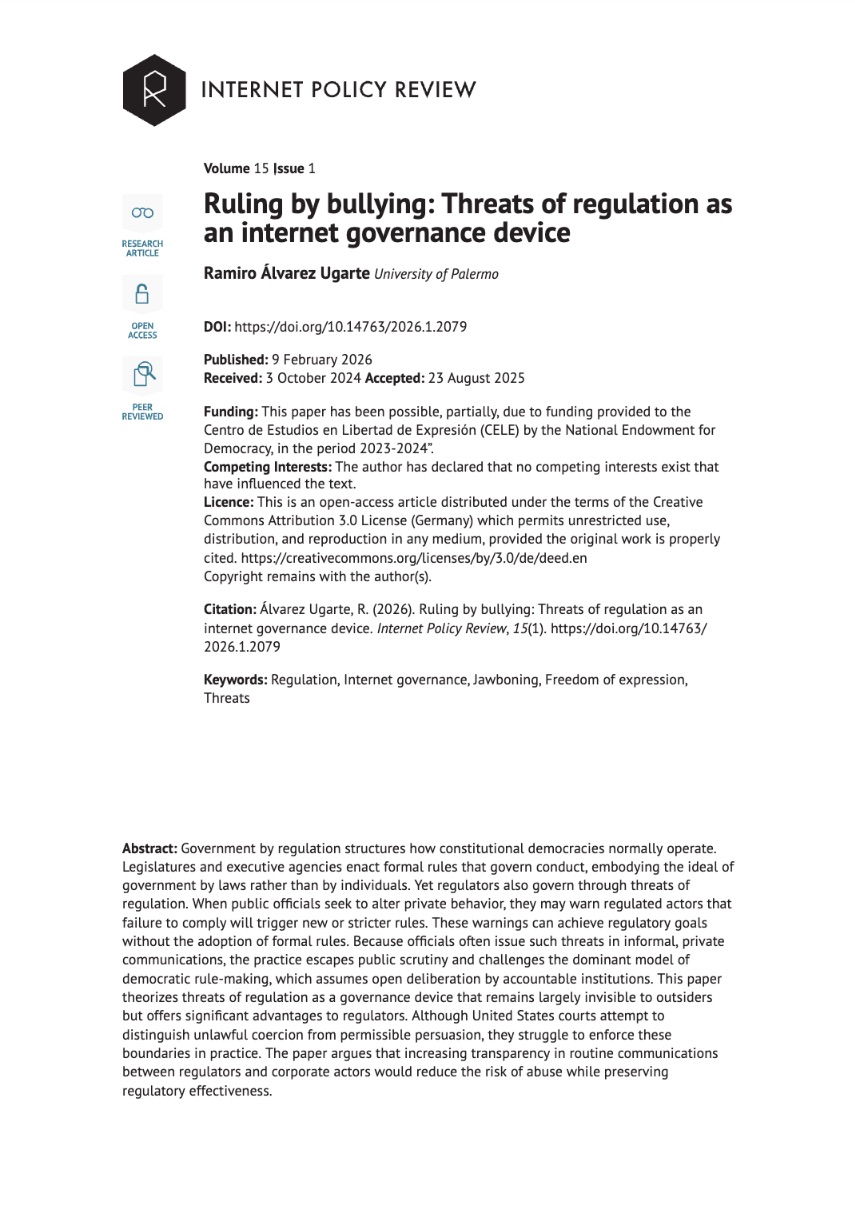
Rullying by Bullying. Threats of regulation as an internet governance device
Government by regulation structures how constitutional democracies normally operate. Legislatures and executive agencies enact formal rules that govern conduct, embodying the ideal of government by laws rather than by individuals. Yet regulators also govern through threats of regulation. When public …
El discurso de odio como modo de censura. Sobre el "caso Biasi" en la Argentina
Agustina Del Campo, Ramiro Álvarez Ugarte, Matías González Mama, Francesca Chocano Villanueva, y Nicolás Zara, “El discurso de odio como modo de censura. Sobre el “caso Biasi” en la Argentina”, Documento de posición No. 37, Centro de Estudios en Libertad de Expresión (CELE), Buenos Aires …
Amicus curiae en el juicio para la protección de los derechos político-electorales del ciudadano promovido por R3D ante el Tribunal Electoral del Poder Judicial de la Federación de México
CELE, “Amicus curiae en el juicio para la protección de los derechos político-electorales del ciudadano promovido por R3D ante el Tribunal Electoral del Poder Judicial de la Federación de México ”, Documento de posición No. 36 (ESP), Centro de Estudios en Libertad de Expresión (CELE), Buenos Aires …
Observaciones del CELE a la Solicitud de Opinión Consultiva sobre Democracia y su protección ante el Sistema Interamericano de Derechos Humanos presentada por Guatemala ante la Corte Interamericana de Derechos Humanos
CELE, “Observaciones del CELE a la Solicitud de Opinión Consultiva sobre Democracia y su protección ante el Sistema Interamericano de Derechos Humanos presentada por Guatemala ante la Corte Interamericana de Derechos Humanos”, Documento de posición No. 35 (ESP), Centro de Estudios en Libertad de …
Tribunal Europeo de Derechos Humanos: Caso de Google LLC y otros contra Rusia
CELE, “Tribunal Europeo de Derechos Humanos: Caso de Google LLC y otros contra Rusia”, Informe de jurisprudencia No. 5 (ESP), Centro de Estudios en Libertad de Expresión (CELE), Buenos Aires (2025) PDF
Legal Approaches to Hate Speech Within the Internet Ecosystem: Speed, Scope, and Scale
The debate over how to de"ne hate speech, particularly in the online world, is far from settled. Defnitions from international documents are still vague and ambiguous, whereas States around the world have been adopting in their respective legal systems diverse definitions of hate speech. In …
Aportación Conjunta de Organizaciones de la Sociedad Civil y Academia sobre la X Cumbre de las Américas: "Construyendo un Hemisferio Seguro, Sostenible y de Prosperidad Compartida"
Article 19, CELE, Derechos Digitales, et al. , “Aportación Conjunta de Organizaciones de la Sociedad Civil y Academia sobre la X Cumbre de las Américas: “Construyendo un Hemisferio Seguro, Sostenible y de Prosperidad Compartida””, Documento de posición No. 33 (ESP), Centro de Estudios en …
Moderating Hate or Moderating Rights? The Paradox of the European Approach to Online Hate Speech and Platform Liability
This paper critically assesses the European approach to regulating online hate speech through platform liability frameworks, focusing on Germany’s Network Enforcement Act (NetzDG) and the European Union’s Digital Services Act. It argues that these laws, while aiming to curb online harm, risk …
CELE submission to the Committee of Ministers’ public consultation on the Draft Guidance Note on the Implications of Generative Artificial Intelligence for Freedom of Expression
Agustina del Campo y Ramiro Álvarez Ugarte, “Trust and Safety’s Blindspots: A Latin American Perspective”, Artículo de investigación No. 68 (ENG), Centro de Estudios en Libertad de Expresión (CELE), Buenos Aires. En Maia Levy Daniel, Amanda Menking, Marlyn Thomas Savio, & Jean Claffey, …
CELE submission to the Committee of Ministers’ public consultation on the draft recommendation on online safety and empowerment of content creators and users
Nicolás Zara, “CELE submission to the Committee of Ministers’ public consultation on the draft recommendation on online safety and empowerment of content creators and users”, Documento de posición No. 32 (ENG), Centro de Estudios en Libertad de Expresión (CELE), Buenos Aires (2025) PDF
Public Consultation on Freedom of Expression and Artificial Intelligence
Vladimir Garay. Matías González Mama, Nicolás Zara, Agustina Del Campo, “Public Consultation on Freedom of Expression and Artificial Intelligence”, Documento de posición No. 30 (ENG), Centro de Estudios en Libertad de Expresión (CELE), Buenos Aires (2025) PDF
CELE submission to the Office of the Special Rapporteur for Freedom of Opinion and Expression
Agustina del Campo y Ramiro Álvarez Ugarte, “Trust and Safety’s Blindspots: A Latin American Perspective”, Artículo de investigación No. 68 (ENG), Centro de Estudios en Libertad de Expresión (CELE), Buenos Aires. En Maia Levy Daniel, Amanda Menking, Marlyn Thomas Savio, & Jean Claffey, …
Trust and Safety's Blindspots: A Latin American Perspective
Trust and safety is slowly but steadily emerging in the United States as an independent field of study and practice. Several initiatives—such as the recent Glossary of Trust and Safety Terms issued by the Digital Trust and Safety Partnership (DTSP)—are attempting to lay the groundwork for a common …
Concepto solicitado por la Corte Constitucional - Acción de tutela presentada por Daniela contra Marcos.
CELE, FLIP, el Veinte y Fundacion Karisma, “Concepto solicitado por la Corte Constitucional - Acción de tutela presentada por Daniela contra Marcos.”, Documento de posición No. 28 (ESP), Centro de Estudios en Libertad de Expresión (CELE), Buenos Aires (2025) PDF
Colombia. Sentencia T-149 de 2025: Violencia de género digital política y libertad de expresión
Lina Palacios, “Colombia. Sentencia T-149 de 2025: Violencia de género digital política y libertad de expresión”, Informe de jurisprudencia No. 4 (ESP), Centro de Estudios en Libertad de Expresión (CELE), Buenos Aires (2025) PDF
República Dominicana – Nuevo Proyecto de Ley Orgánica de Libertad de Expresión y Medios Audiovisuales
CELE, “El Nuevo Proyecto de Ley Orgánica de Libertad de Expresión y Medios Audiovisuales”, Informe legislativo No. 15 (ESP), Centro de Estudios en Libertad de Expresión (CELE), Buenos Aires (2025) PDF
Global AI Governance: Who Regulates, with what Approach, and for Whom?
This report presents a mapping of the main international, regional and national regulatory initiatives on artificial intelligence. In a scenario characterized by a growing normative competition to define regulatory models in the subject, most initiatives have points in common but—in many …
Emerging Technologies and Human Rights from the Perspective of the Inter-American Legal Framework
This article seeks to introduce the main challenges posed by emerging technologies and highlight some human rights standards within the framework of the Inter-American Human Rights System (SIDH) that can contribute to the debate and guide responses. Without aspiring to an exhaustive analysis, the …
Contribution to the preparation of the report on the challenges and risks regarding discrimination and the unequal enjoyment of the right to privacy associated with the collection and processing of data
CELE, “Contribution to the preparation of the report on the challenges and risks regarding discrimination and the unequal enjoyment of the right to privacy associated with the collection and processing of data”, Documento de posición No. 27 (ENG), Centro de Estudios en Libertad de Expresión (CELE), …
Submission in response to the Call for Evidence in connection with the development of the European Democracy Shield
CELE, “Submission in response to the Call for Evidence in connection with the development of the European Democracy Shield”, Documento de posición No. 26 (ENG), Centro de Estudios en Libertad de Expresión (CELE), Buenos Aires (2025) PDF
Reclaiming Human Rights for Platform Governance: Proposals for Restoring Their Centrality in the Era of Risks
The Digital Services Act can potentially become a tool for change toward a more rights-abiding, competitive European digital platform ecosystem. However, as it currently stands, it is prone to be misused as a powerful tool for censorship as well as a tool to displace human rights as the backbone of …
Comentarios al proyecto de Ley Modelo Interamericana para prevenir, sancionar y erradicar la violencia digital contra las mujeres por razones de género
CELE, “Comentarios al proyecto de Ley Modelo Interamericana para prevenir, sancionar y erradicar la violencia digital contra las mujeres por razones de género”, Documento de posición No. 25 (ESP), Centro de Estudios en Libertad de Expresión (CELE), Buenos Aires (2025) PDF
México. Amparo en revisión 767/2023 y principio de no responsabilidad de intermediarios
Matías González Mama y Francesca Chocano, “México. Amparo en revisión 767/2023 y principio de no responsabilidad de intermediarios”, Informe de jurisprudencia No. 3 (ESP), Centro de Estudios en Libertad de Expresión (CELE), Buenos Aires (2025) PDF
Digital Constitutionalism in Latin America
Digital constitutionalist theorists propose a framework to analyze and potentially resolve power struggles in the digital age, particularly—although not exclusively—power struggles over content management. The concept is proposed as both a historical moment and a theoretical framework …
CELE’s input on recurrent and prominent systemic risks in the EU and on measures for their mitigation
Nicolás Zara, “CELE’s input on recurrent and prominent systemic risks in the EU and on measures for their mitigation”, Documento de posición No. 34 (ENG), Centro de Estudios en Libertad de Expresión (CELE), Buenos Aires (2025) PDF
Brasil - Análisis de la Constitucionalidad del Artículo 19 del Marco Civil de Internet
Matías González Mama y Francesca Chocano, “Brasil - Análisis de la Constitucionalidad del Artículo 19 del Marco Civil de Internet”, Informe de jurisprudencia No. 2 (ESP), Centro de Estudios en Libertad de Expresión (CELE), Buenos Aires (2025) PDF
Colombia – Proyecto de Ley 261/2024 que regula el acceso a menores de edad a redes sociales
CELE, “Ficha Legislativa sobre PL Colombia que regula acceso a menores de edad a redes sociales”, Informe legislativo No. 14, Centro de Estudios en Libertad de Expresión (CELE), Buenos Aires (2025) PDF
Regulatory Modeling. Tracking the Influence of the Digital Services Act in Latin America
This article discusses the Digital Services Act (DSA) of the European Union as a possible candidate for a process of regulatory modeling, one of the mechanisms through which the laws of a country or a region migrate to other countries. It is a relatively usual global phenomenon, in which it is …
Old Standards, New Challenges: Keys to Addressing Internet Disinformation in Inter-American Jurisprudence
On May 3, 2020, as part of World Press Freedom Day and just a few months into an unprecedented health emergency, the UN Secretary-General stated that disinformation had become the “second pandemic.” More recently, a resolution of the United Nations Human Rights Council described disinformation as “a …
Brasil - Proyecto de Ley 4691/2024 sobre la Protección de las Libertades Constitucionales y Derechos Fundamentales en las plataformas, servicios y mercados digitales en Internet.
Matías Gonzalez Mama y Francesca Chocano, “Brasil - Proyecto de Ley 4691/2024 sobre la Protección de las Libertades Constitucionales y Derechos Fundamentales en las plataformas, servicios y mercados digitales en Internet. ”, Informe legislativo No. 13, Centro de Estudios en Libertad de Expresión …
Are Risks the New Rights? The Perils of Risk-based Approaches to Speech Regulation
This paper discusses the risk-based approach of the Digital Services Act (DSA) of the European Union. By embracing open-ended standards instead of rules and by imposing broad risk-identification and mitigation obligations on private parties, the DSA pushes forward a form of managerial co-regulation …
Best Practices to Guide Dialogue between the Judiciary and the Press. A Guide for Judges and Journalists
In the relationship between the judiciary and the press there are a series of conventions and habits that have shaped a culture of legal and judicial information over the years. Often, this culture generates a series of tensions between both actors, which also affects public opinion. In this …
Análisis de Jurisprudencia en casos recientes de libertad de expresión e Internet
CELE, “Análisis de Jurisprudencia en casos recientes de libertad de expresión e Internet”, Informe de jurisprudencia No. 1, Centro de Estudios en Libertad de Expresión (CELE), Buenos Aires (2025) PDF
Submission in response to OFCOM’s call for evidence regarding “Researchers’ access to information from regulated online services”
CELE, “Submission in response to OFCOM’s call for evidence regarding “Researchers’ access to information from regulated online services””, Documento de posición No. 24, Centro de Estudios en Libertad de Expresión (CELE), Buenos Aires (2025) PDF
Submission to the Thematic Report on "Freedom of Expression and Elections in the Digital Age"
CELE, “Submission to the Thematic Report on “Freedom of Expression and Elections in the Digital Age””, Documento de posición No. 23, Centro de Estudios en Libertad de Expresión (CELE), Buenos Aires (2025) PDF
Submission in response to the Public Consultation on the draft delegated act on access to online platform data for vetted researchers under the Digital Services Act (DSA)
CELE & Internetlab, “Submission in response to the Public Consultation on the draft delegated act on access to online platform data for vetted researchers under the Digital Services Act (DSA)”, Documento de posición No. 22 (ENG), Centro de Estudios en Libertad de Expresión (CELE), Buenos Aires …
Submission in response to OFCOM'S Consultation on transparency guidance
CELE, “Submission in response to OFCOM’S Consultation on transparency guidance”, Documento de posición No. 21, Centro de Estudios en Libertad de Expresión (CELE), Buenos Aires (2024) PDF
Alternative Solutions to Disinformation: Addressing Sources Instead of Distribution
In the increasingly concentrated online public sphere, the easiest and fastest way to tackle content perceived as dangerous, such as disinformation, is to control its dissemination. In recent years, internet companies have increasingly removed or blocked content—including that of heads of …
Submission in response to the Call for Evidence for the development of guidelines for the protection of minors under Article 28 (4) of the DSA
CELE, “Submission in response to the Call for Evidence for the development of guidelines for the protection of minors under Article 28 (4) of the DSA”, Documento de posición No. 20, Centro de Estudios en Libertad de Expresión (CELE), Buenos Aires (2024) PDF
Uruguay – Antecedentes y debate sobre el proyecto de Ley de Medios
Matías Gonzalez Mama y Francesca Chocano, “Antecedentes y debate sobre el proyecto de Ley de Medios recientemente aprobado en Uruguay”, Informe legislativo No. 12, Centro de Estudios en Libertad de Expresión (CELE), Buenos Aires (2024) PDF
Amicus curiae en la causa "Gisele Zuni Mousques c/Christian Chena Y Otros s/ violencia contra la mujer" (Paraguay)
TEDIC, CELE, y Wikimedia Foundation, “Amicus curiae en la causa “Gisele Zuni Mousques c/Christian Chena Y Otros s/ violencia contra la mujer” (Paraguay)”, Documento de posición No. 18, Centro de Estudios en Libertad de Expresión (CELE), Buenos Aires (2024) PDF
Amicus curiae en la acción de tutela interpuesta por José Manuel Vega de la Cruz en contra de la Gobernación del Departamento de Cesar (Corte Constitucional de Colombia)
CELE, “Amicus curiae en la acción de tutela interpuesta por José Manuel Vega de la Cruz en contra de la Gobernación del Departamento de Cesar (Corte Constitucional de Colombia)”, Documento de posición No. 19, Centro de Estudios en Libertad de Expresión (CELE), Buenos Aires (2024) PDF
On the Metaphor of Social Media as a Public Forum in the United States
The goal of this study is to define the scope of the public forum doctrine in the United States and assess its applicability to social media. Although this research is conducted from a Latin American perspective, the focus on the United States is justified for two reasons. First, one of the earliest …
Chile - Proyecto de ley sobre “trastornos” de la información en línea
CELE, “Chile - Proyecto de ley sobre “trastornos” de la información en línea”, Informe legislativo No. 11, Centro de Estudios en Libertad de Expresión (CELE), Buenos Aires (2024) PDF
A Latin American Perspective on Global Governance for Digital Platform Accountability. Access Now and CELE's Submission to the T20 process.
Agneris Sampietri, Ramiro Álvarez Ugarte, Matías González Mama, “A Latin American Perspective on Global Governance for Digital Platform Accountability. Access Now and CELE’s Submission to the T20 process. ”, Documento de posición No. 17 (ENG), Centro de Estudios en Libertad de Expresión …
Amicus curiae Ulrich Richter Morales y Claudia Ramírez Tavera vs. Google Inc. y Google México
CELE, “Amicus curiae Ulrich Richter Morales y Claudia Ramírez Tavera vs. Google Inc. y Google México”, Documento de posición No. 13, Centro de Estudios en Libertad de Expresión (CELE), Buenos Aires (2024) PDF
Online gender-based violence and freedom of expression: a study of six cases in Paraguay
This study focuses on the application and potential misinterpretation of Law 5777/16 in Paraguay, which addresses comprehensive protection for women against all forms of violence, and the use of its precautionary measures in cases of public interest that may negatively impact freedom of expression. …
Submission on European Commission Consultation on the draft Digital Services Act (DSA) guidelines on the integrity of electoral processes
CELE, “Submission on European Commission Consultation on the draft Digital Services Act (DSA) guidelines on the integrity of electoral processes”, Documento de posición No. 16, Centro de Estudios en Libertad de Expresión (CELE), Buenos Aires (2024) PDF
Submission on OFCOM’s Consultation: Protecting people from illegal harms online
CELE, “Submission on OFCOM’s Consultation: Protecting people from illegal harms online”, Documento de posición No. 15, Centro de Estudios en Libertad de Expresión (CELE), Buenos Aires (2024) PDF
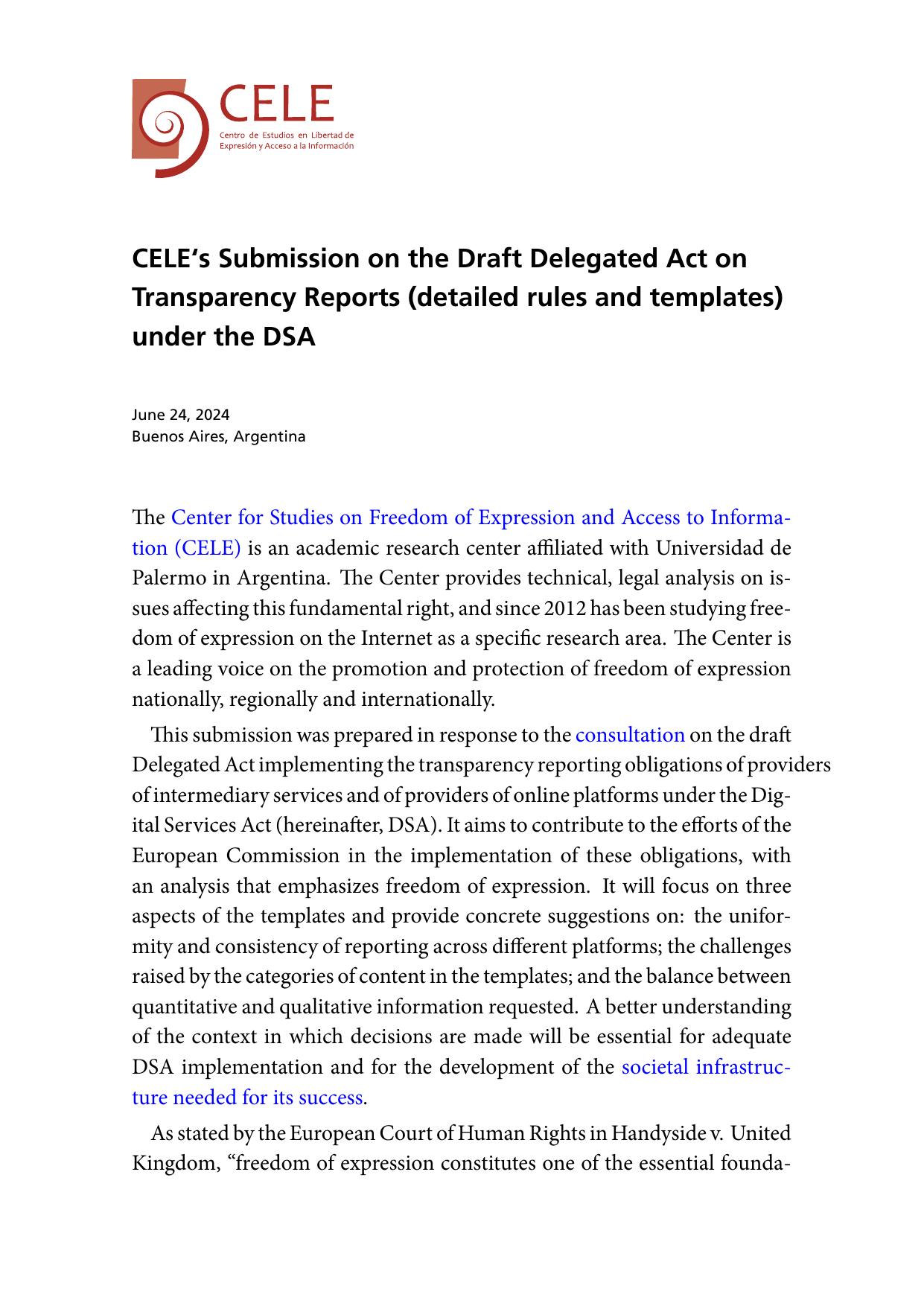
Submission on the Draft Delegated Act on Transparency Reports (detailed rules and templates) under the DSA
CELE, “Submission on the Draft Delegated Act on Transparency Reports (detailed rules and templates) under the DSA”, Documento de posición No. 14, Centro de Estudios en Libertad de Expresión (CELE), Buenos Aires (2024) PDF
OSINT Practices: Friends or Enemies of Human Rights?
This research will define OSINT as the collection and analysis of open-source data—whether personal or not—for a specific purpose. That purpose may or may not be for-profit; related to surveillance, scientific or academic research; or purely personal. This paper aims to serve as an initial diagnosis …
La penalización de actos de blasfemia en Dinamarca.
CELE, “La penalización de actos de blasfemia en Dinamarca. ”, Informe legislativo No. 11, Centro de Estudios en Libertad de Expresión (CELE), Buenos Aires (2023) PDF
Amicus curiae Colombia (violencia política)
CELE, “Amicus curiae Colombia (violencia política)”, Documento de posición No. 12, Centro de Estudios en Libertad de Expresión (CELE), Buenos Aires (2023) PDF
Proyecto de ley contra la violencia de género en la vida política de la mujer.
Matías Gonzalez Mama y Lina Paola Velásquez Veloza, “Proyecto de ley contra la violencia de género en la vida política de la mujer.”, Informe legislativo No. 10, Centro de Estudios en Libertad de Expresión (CELE), Buenos Aires (2023) PDF
Open Source Intelligence (OSINT) and Human Rights in Latin America: A comparative Report on Argentina, Brazil, Colombia, Mexico, and Uruguay
The use of OSINT by the state for surveillance purposes presents specific challenges regarding human rights. These tools can lead to violations of fundamental rights and are often employed outside the boundaries of legality. As this study will show, their use is generally unregulated, and where …
CELE's Submission for the Call for Papers on Global AI Governance of the Office of the UN Secretary General's Envoy on Technology
CELE, “CELE’s Submission for the Call for Papers on Global AI Governance of the Office of the UN Secretary General’s Envoy on Technology”, Documento de posición No. 11, Centro de Estudios en Libertad de Expresión (CELE), Buenos Aires (2023) PDF
Brasil – Proyecto de ley de noticias falsas
Matías Gonzalez Mama y Lina Paola Velásquez Veloza, “Nuevas discusiones sobre el proyecto de ley de noticias falsas en Brasil. ”, Informe legislativo No. 9, Centro de Estudios en Libertad de Expresión (CELE), Buenos Aires (2023) PDF
Open Source Intelligence (OSINT) in Argentina: A Diagnosis of its Use by the State
The current global landscape shows a growing trend in the development, acquisition, and use of mass surveillance technologies by states. The regional context is no different. This trend intensified with the increased use of such technologies following the onset of the COVID-19 pandemic. Moreover, …
CELE's Submission on Glossary of Trust & Safety Terms
CELE, “CELE’s Submission on Glossary of Trust & Safety Terms”, Documento de posición No. 10, Centro de Estudios en Libertad de Expresión (CELE), Buenos Aires (2023) PDF
Amicus curiae Colombia (pena de prisión)
CELE, “Amicus curiae Colombia (pena de prisión)”, Documento de posición No. 10, Centro de Estudios en Libertad de Expresión (CELE), Buenos Aires (2023) PDF
The Free Speech Recession Hits Home Mapping Laws and Regulations Affecting Free Speech in 22 Open Democracies de 2023
Justitia and the authors, “The Free Speech Recession Hits Home Mapping Laws and Regulations Affecting Free Speech in 22 Open Democracies de 2023”, Informe legislativo No. , Centro de Estudios en Libertad de Expresión (CELE), Buenos Aires (2023)
Requiring the Local Presence of ICT Companies: An International Human Rights Law and International Economic Law Perspective
Recently, we have seen a proliferation of laws and legislative proposals worldwide that impose the creation of some form of legal-commercial link or local connection between information and communication technology (ICT) companies—mainly social media platforms—and the countries where they operate. …
Platform Oversight: A Neglected Link in Internet’s Regulatory Futures
Since the mid-2000s, there have been multiple and wide-ranging proposals for traditional regulation, co-regulation, and self-regulation of digital platforms and Internet companies. The proliferation of regulatory proposals, framework agreements between states and companies, and unilateral …
Iniciativas legislativas sobre privacidad y protección de datos en Argentina, Brasil, Chile, Colombia, Ecuador, México, Guatemala, Paraguay y Perú, período 2019-2021
Olga Lucía Camacho Gutiérrez y Lina Paola Velásquez Veloza, “Iniciativas legislativas sobre privacidad y protección de datos en Argentina, Brasil, Chile, Colombia, Ecuador, México, Guatemala, Paraguay y Perú, período 2019-2021”, Informe legislativo No. 8, Centro de Estudios en Libertad de Expresión …
Nueva actualización de la Ley de Protección de Datos Personales
Matías Gonzalez Mama y Lina Paola Velásquez Veloza, “Nueva actualización de la Ley de Protección de Datos Personales”, Informe legislativo No. 5, Centro de Estudios en Libertad de Expresión (CELE), Buenos Aires (2022) PDF
La nueva Ley de Servicios Digitales europea
Olga Lucía Camacho Gutiérrez, “La nueva Ley de Servicios Digitales europea”, Informe legislativo No. 6, Centro de Estudios en Libertad de Expresión (CELE), Buenos Aires (2022) PDF
La nueva Ley de Mercados Digitales europea
Olga Lucía Camacho Gutiérrez, “La nueva Ley de Mercados Digitales europea”, Informe legislativo No. 7, Centro de Estudios en Libertad de Expresión (CELE), Buenos Aires (2022) PDF
Proyecto de ley de “seguridad en línea” de Reino Unido
Olga Lucía Camacho Gutiérrez, “Proyecto de ley de “seguridad en línea” de Reino Unido”, Informe legislativo No. 3, Centro de Estudios en Libertad de Expresión (CELE), Buenos Aires (2022) PDF
Ley de Florida (SB 7072) sobre moderación de contenidos en las redes sociales
Lina Paola Velásquez Veloza, “Ley de Florida (SB 7072) sobre moderación de contenidos en las redes sociales”, Informe legislativo No. 4, Centro de Estudios en Libertad de Expresión (CELE), Buenos Aires (2022) PDF
Aprobación en ciernes de la ley canadiense Online Streaming Act
Olga Lucía Camacho Gutiérrez, “Aprobación en ciernes de la ley canadiense Online Streaming Act”, Informe legislativo No. 2, Centro de Estudios en Libertad de Expresión (CELE), Buenos Aires (2022) PDF
Supporting Media Viability in the Americas. Towards Sustainable Journalism
If journalism is an essential gear of democracy, then democracy is somewhat in danger. While the Internet has offered the world unparalleled access to information, journalism as an industry is in crisis. In many countries around the world, but especially in Latin America, the possibility of making a …
Reporte final de la Comisión de Derecho del Reino Unido Leyes sobre crímenes de odio
Matías González Mama, “Reporte final de la Comisión de Derecho del Reino Unido Leyes sobre crímenes de odio”, Informe legislativo No. 1, Centro de Estudios en Libertad de Expresión (CELE), Buenos Aires (2022) PDF
The Regulation of Freedom of Expression in Latin America: Findings, Trends, and Legislative Challenges
For more than a decade, various legislatures across Latin America have been enacting laws and proposing initiatives aimed at directly or indirectly regulating the digital space. These spaces are an essential part of the personal, political, and cultural lives of millions of people. Moreover, they …
Amicus Curiae: el caso Natalia Denegri contra Google
Agustina del Campo y Ramiro Álvarez Ugarte, “Amicus Curiae: el caso Natalia Denegri contra Google”, Documento de posición No. 9, Centro de Estudios en Libertad de Expresión (CELE), Buenos Aires (2022) PDF
Legislation and its Effects: Some Experiences from Comparative Law
Assessing the impact of enacted laws in terms of human rights is particularly relevant when considering freedom of expression. The role of state regulations in shaping public debate has been a central concern for those who have reflected on freedom of expression from the outset. Regardless of …
Are Public Officials’ Lies Unsustainable or Do they Have Far Reaching Effects?
State responses to the recent “crisis” caused by misinformation in social media have mainly aimed at penalizing its authors or establishing liability for those who facilitate its dissemination. Internet companies, especially large platforms, have deployed numerous techniques, measures, and …
The New Normal? Disinformation and Content Control on Social Media during COVID-19
This document addresses the measures that Facebook, Twitter, and YouTube implemented to address problematic content related to COVID-19 on their platforms. Known mainly as community guidelines, these rules are the basis for the moderation actions carried out by these services on user content. The …
Looking South: Towards New Regional Consensus on Internet Intermediary Liability
In Latin America, there is no consensus on the appropriate regulations for dealing with internet intermediary liability. The Office of the Special Rapporteur for Freedom of Expression of the OAS established regional guidelines for regulating intermediary liability in 2013 and 2016, aiming to protect …
Disinformation in Democracy or the Democracy of Disinformation?
Disinformation on the Internet has been the object of concern and action by multiple actors. While at first the measures were more targeted to train and cooperate in detecting false news, there are currently more and more measures whose implementation involves censorship, blocks, controls, and …
Fake News on the Internet: Actions and Reactions of Three Plataforms
In the past four years, online misinformation has become a seemingly novel threat to Western democracies. This threat surfaces in a time of anxiety about the future: democratic systems appear to be going through a crisis as a result of the consolidation of political options that, even if they do not …
Analysis of the Debate Process on Legal Initiatives for Personal Data Protection and their Conflicts with the Right to Freedom of Expression: The Cases of Argentina and Ecuador
Over the past decades, several Latin American countries have debated legislative proposals aimed at regulating the protection of personal data and privacy, driven by the growing developments in information and communication technologies. These advances have revealed that existing legislation is …
Libertad de expresión en el Poder Legislativo brasileño: temas y tendencias
Thiago Dias Oliva, Clarice Tavares Macedo y Victor Pavarin Tavares, “Libertad de expresión en el Poder Legislativo brasileño: temas y tendencias”, Informe legislativo No. , Centro de Estudios en Libertad de Expresión (CELE), Buenos Aires (2020) PDF
Human Rights Impact Assessments: Trends, Challenges, And Opportunities for ICT Sector Adoption
In our previous work, we sought to place human rights impacts assessments (HRIA) within their history. We showed how the institute comes from a set of corporate practices that rest uncomfortably within different frameworks. On the one hand, HRIAs stem from the environmental impact assessments …
Disinformation in Democracy or Democracy of Disinformation?
Disinformation on the Internet has been the subject of concern and action by multiple actors. While at first the measures were more geared towards training and collaborating in the detection of fake news, more and more measures are being implemented that involve censorship, blockages, controls and …
ICT and Human Rights: Towards a Conceptual Framework of Human Rights Impact Assessments
The development of Human Rights Impact Assessments (HRIAs) has gained increasing attention as a tool for evaluating the intersection between corporate practices and human rights. Initially framed within the United Nations Guiding Principles on Business and Human Rights (UNGPs) , particularly the …
Freedom of Expression and the Digital Gender Gap in Mexico
The digital age has transformed access to information and the exercise of fundamental rights, including freedom of expression. However, a significant digital divide persists, exacerbating existing inequalities, particularly for women and marginalized communities in Mexico. This paper explores the …
The Tension between the Protection of Intellectual Property and the Exchange of Content on the Internet. Regarding the Cuevana Case in Argentina and the 'Lleras Law' in Colombia
This document takes the case of Cuevana—where an Argentine judge ordered the blocking of several pages of this website due to a possible violation of copyright laws—as a starting point to analyze the tension between intellectual property protection and content sharing on the internet. Drawing on the …
Institutional Development in Internet Governance and Civil Society Participation: An Assessment of Challenges and Prospects from the Technical Community Perspective
This brief essay evaluates the role of civil society organizations from the perspective of someone who has been involved in internet governance for a decade as a member of the academic and technical communities. In addition to a historical assessment, the text: (i) highlights the importance of …
Democratic Rule of Law and Internet Governance: The Key Role of Judicial Operators
A key part of what we understand as multistakeholder internet governance is defined by what we consider to be stakeholders: governments, the private sector, organized civil society, academia, and the technical community. It goes without saying that each of these broad actors conceptually encompasses …
From Comics to Memes: Old and New Issues Surrounding Humor and Freedom of Expression
In 2018, the “Save the meme” campaign sparked global attention among the online human rights activist community. Under the slogan “No memes, no democracy,” numerous international organizations joined together to collect signatures against the reform of the European copyright directive, which they …
Tendencias legislativas sobre libertad de expresión e internet en Paraguay
Camilo J. Filártiga Callizo, “Tendencias legislativas sobre libertad de expresión e internet en Paraguay”, Informe legislativo No. 11, Centro de Estudios en Libertad de Expresión (CELE), Buenos Aires (2019) PDF
Tendencias en libertad de expresión en Guatemala
Álvaro Castellanos Howell, “Tendencias en libertad de expresión en Guatemala”, Informe legislativo No. 12, Centro de Estudios en Libertad de Expresión (CELE), Buenos Aires (2019) PDF
Tendencias de la libertad de expresión en Colombia
Luisa Fernanda Isaza, “Tendencias de la libertad de expresión en Colombia”, Informe legislativo No. , Centro de Estudios en Libertad de Expresión (CELE), Buenos Aires (2019) PDF
Libertad de expresión y de discurso en Chile: desafíos y tensiones en el tránsito hacia una sociedad digital
Patricia Peña, “Libertad de expresión y de discurso en Chile: desafíos y tensiones en el tránsito hacia una sociedad digital”, Informe legislativo No. , Centro de Estudios en Libertad de Expresión (CELE), Buenos Aires (2019) PDF
Guardians of the Access to Public Information Act: Analysis of the Implementation of the Guarantor Bodies
The sanction of Law No. 27,275 on Access to Public Information constitutes a historic milestone in Argentina in the advance towards an institutional and democratic opening towards citizens. The law came into force one year after its publication, on September 29, 2017, with the objective of putting …
WhatsApp, Mobile Politics and Disinformation: How did Fake News Go Viral in the Brazilian Elections?
This paper examines the role of WhatsApp as a vehicle for the dissemination of disinformation during the 2018 Brazilian presidential elections. Given WhatsApp’’s widespread adoption in Brazil—where over 120 million users rely on the platform—its use as a political mobilization tool has …
Secrets and Lies: WhatsApp and Social Media in Brazil's 2018 Presidential Election
The 2018 Brazilian presidential elections marked a turning point in the role of digital platforms in political campaigns, with WhatsApp emerging as a central tool for information dissemination, mobilization, and disinformation. This study examines the use of WhatsApp as a mechanism for political …
Considering Facebook Oversight Board: Turning on Expectations
The International Criminal Court is popularly referred to as the “world Court”. With Facebook’s announcement to create an appeals, independent body to review the application and enforcement of its terms of service over its 2.7 billion users all around the globe, the term …
The Implementation of "Digital Oblivion": Forgetting the Details
Technological advancement and the expansion of the Internet have transformed the way information is stored, shared and accessed. However, this permanent access poses significant challenges in terms of privacy, reputation and freedom of expression. The “right to be forgotten” emerges as a tool to …
Tendencias en libertad de expresión en Perú
CELE, “Tendencias en libertad de expresión en Perú”, Informe legislativo No. , Centro de Estudios en Libertad de Expresión (CELE), Buenos Aires (2018) PDF
Tendencias en libertad de expresión en México
CELE, “Tendencias en libertad de expresión en México”, Informe legislativo No. , Centro de Estudios en Libertad de Expresión (CELE), Buenos Aires (2018) PDF
Tendencias en libertad de expresión en Ecuador
CELE, “Tendencias en libertad de expresión en Ecuador”, Informe legislativo No. , Centro de Estudios en Libertad de Expresión (CELE), Buenos Aires (2018) PDF
Tendencias en libertad de expresión en Argentina
CELE, “Tendencias en libertad de expresión en Argentina”, Informe legislativo No. , Centro de Estudios en Libertad de Expresión (CELE), Buenos Aires (2018) PDF
Fake News on the Internet: The Strategy to Combat Misinformation
The article explains the measures that Facebook and Google have announced to combat misinformation and includes a brief reference to YouTube and Twitter. Likewise, the paper attempts to determine what the geographical coverage of these measures will be. Subsequently, as a conclusion, it exposes what …
Criminalization of Discriminatory Expression in the Americas: The Case of Non-Consensual Pornography Regulation in Argentina
This article, based on a contribution to the 2018 report of the United Nations Special Rapporteur on violence against women, addresses the growing trend in Latin America toward the criminalization of online speech. Often, initiatives that pursue well-intentioned objectives of combating …
Content Moderation and Private Censorship: Standards Drawn from the Jurisprudence of the Inter-American Human Rights System
This submission seeks to bring some of the standards that could be drawn from the Inter-American Human Rights System to the questions posed by the Rapporteur in his call for submissions on Private content regulation in the digital age. In the words of the Rapporteur, “Private companies facilitate an …
Amicus curiae ante la Corte Suprema en el caso Cecilia Pando c/ Revista Barcelona
Agustina Del Campo, “Amicus curiae ante la Corte Suprema en el caso Cecilia Pando c/ Revista Barcelona”, Documento de posición No. 8, Centro de Estudios en Libertad de Expresión (CELE), Buenos Aires (2017) PDF
Over-the-Top Services: Fundamental Principles for their Regulatory Treatment in Argentina
The article aims to point out the main principles to be taken into account when analysing the regulatory framework for Over the Top services (OTTs). It provides a description of the current regulatory situation in Argentina, as well as arguments for and against the regulation of OTTs, and a section …
Comentarios a los Principios sobre la protección de la libertad de expresión y la privacidad de Article 19
CELE, “Comentarios a los Principios sobre la protección de la libertad de expresión y la privacidad de Article 19”, Documento de posición No. 7, Centro de Estudios en Libertad de Expresión (CELE), Buenos Aires (2016) PDF
Internet Access in Argentina. Lessons Learnt from the Argentina Conectada Plan
This report aims to provide an analysis of some aspects of the implementation of the national broadband plan Argentina Conectada. Given that internet access is key to the realisation of fundamental rights and, therefore, states must actively promote it, the effective implementation of plans such as …
The Offence of ‘Grooming’ in Current and Projected Legislation in Argentina
The crime of ‘grooming’ has been included in the Argentinean Criminal Code by means of Law No. 26.904 in 2013, the text of which caused controversy among different sectors. This report analyses the current and projected Argentinean legislation on this crime, both in the Criminal Code regulations and …
The Regulation of Non-Consensual Pornography in Argentina
This document, written by Paula Vargas de Brea - CELE researcher - addresses the issue of the regulation of non-consensual pornography on the internet, with the aim of providing a description of the current law that allows for its application or to determine whether another type of regulation is …
Responsabilidad de intermediarios y derecho al olvido. Aportes para la discusión legislativa en Argentina
Verónica Ferrari y Daniela Schnidrig, “Responsabilidad de intermediarios y derecho al olvido. Aportes para la discusión legislativa en Argentina”, Documento de posición No. 6, Centro de Estudios en Libertad de Expresión (CELE), Buenos Aires (2015) PDF
Markets, Ownership, Expression and Personal Use: The Copyright System
CELE Research Paper No. 24
Contribuciones al informe de UNESCO "Fostering Freedom Online: the Role of Internet Intermediaries"
MacKinnon Rebecca, Hickok Elonnai, Bar Allon and Lim, Hae-in, “Contribuciones al informe de UNESCO “Fostering Freedom Online: the Role of Internet Intermediaries””, Informe legislativo No. , Centro de Estudios en Libertad de Expresión (CELE), Buenos Aires (2015) PDF
The ‘Internet of Things’: More Internet than Anything Else
CELE Research Paper No. 23
Internet Governance: The Trap of Forms
CELE Research Paper No. 22
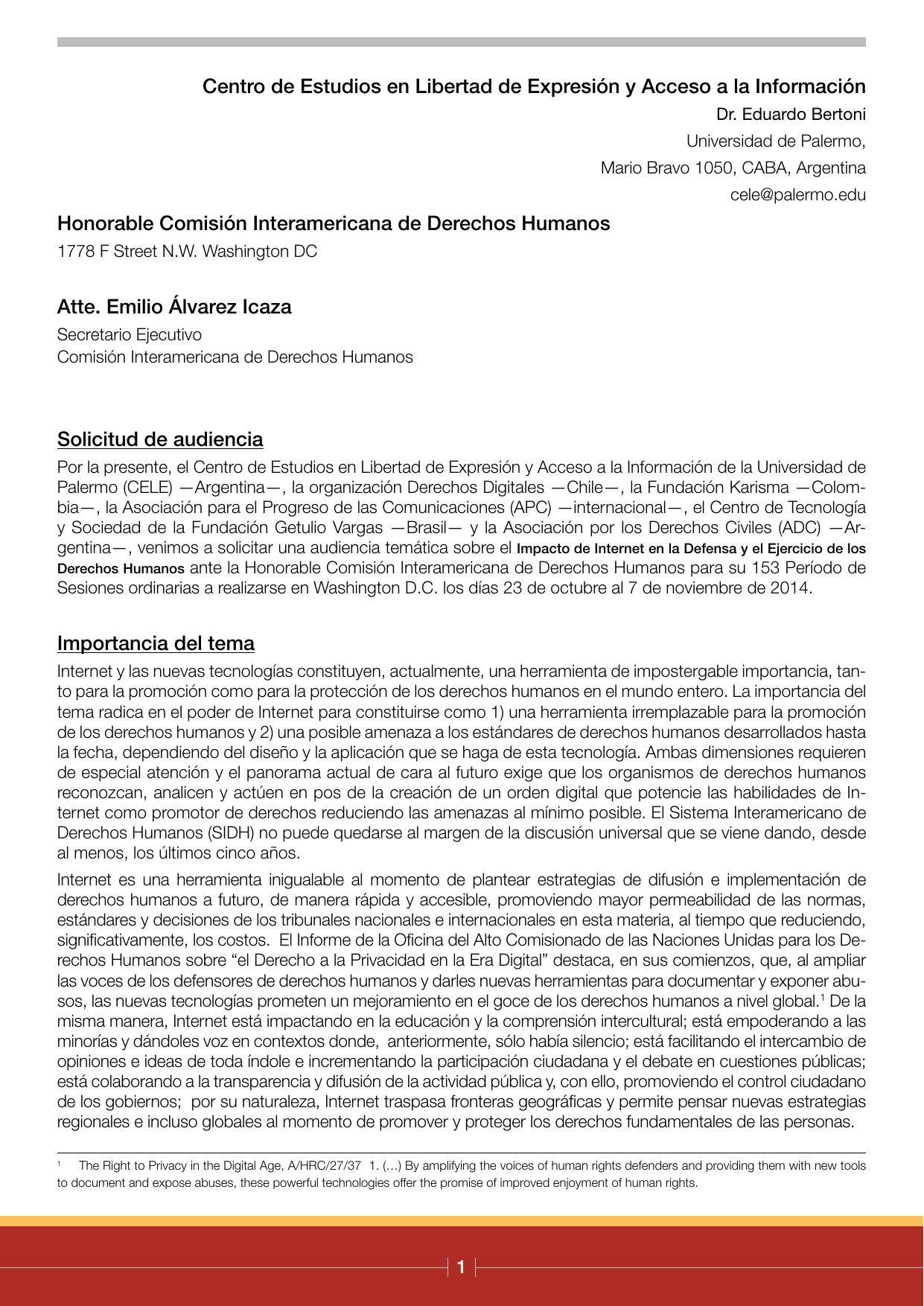
Pedido de audiencia temática a la CIDH sobre el impacto de internet en la defensa y el ejercicio de los derechos humanos
Dr. Eduardo Bertoni, “Pedido de audiencia temática a la CIDH sobre el impacto de internet en la defensa y el ejercicio de los derechos humanos”, Documento de posición No. 4, Centro de Estudios en Libertad de Expresión (CELE), Buenos Aires (2014) PDF
Amicus curiae a la Corte Suprema en el caso María Belén Rodríguez c/ Google
Eduardo Andrés Bertoni, “Amicus curiae a la Corte Suprema en el caso María Belén Rodríguez c/ Google”, Documento de posición No. 5, Centro de Estudios en Libertad de Expresión (CELE), Buenos Aires (2014) PDF
Internet in Argentina: Where are we Today? Mapping the Situation in Terms of Regulatory Access and Human Rights
CELE Research Paper No. 20
Towards a Comprehensive Public Information Management Policy: Everything we Always Wanted to Know About Archives (and Never Dared to ask Access to Information)
CELE Research Paper No. 19
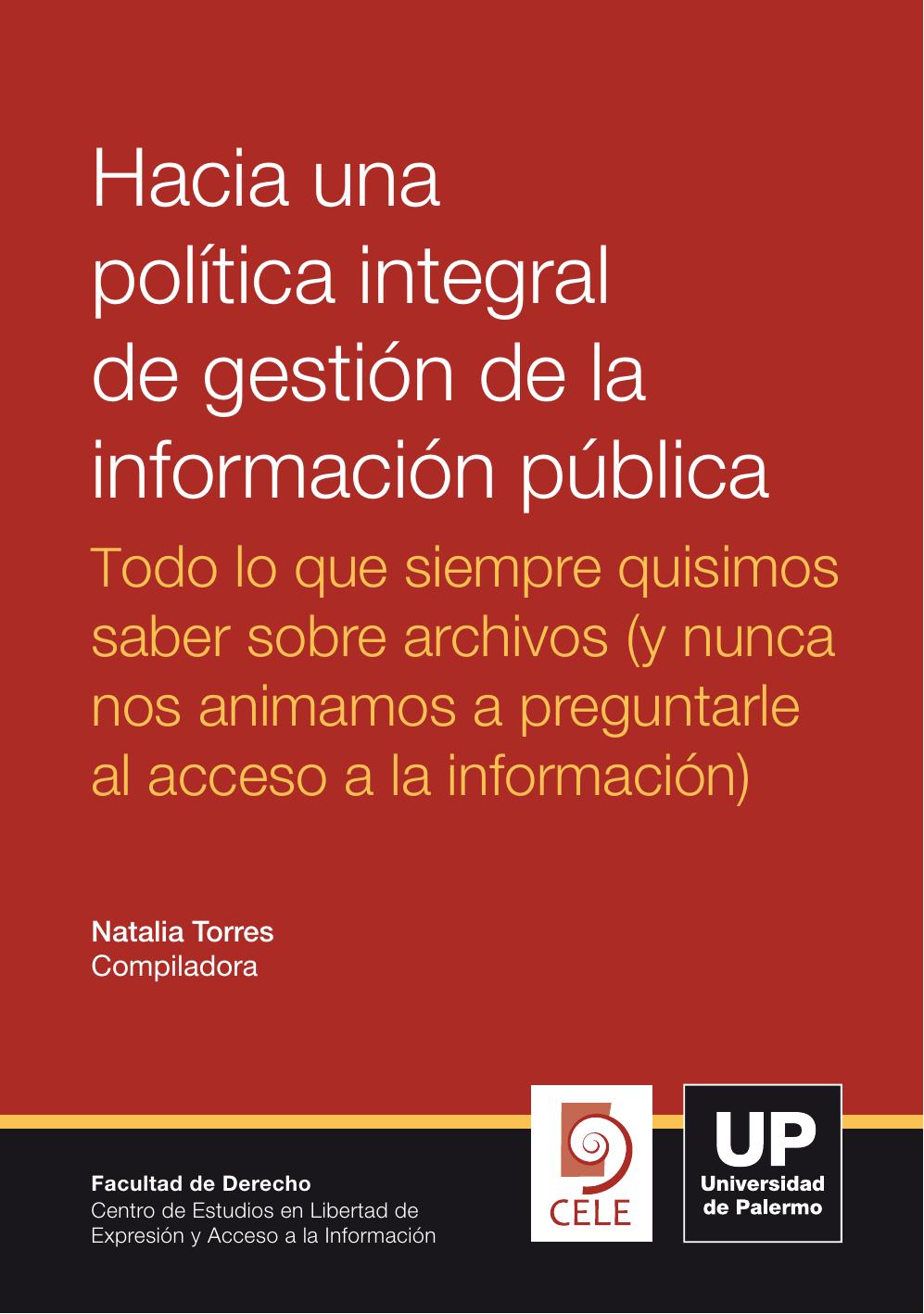
Carta de Derechos Humanos y Principios de Internet
CELE, “Carta de Derechos Humanos y Principios de Internet”, Documento de posición No. 3, Centro de Estudios en Libertad de Expresión (CELE), Buenos Aires (2014) PDF
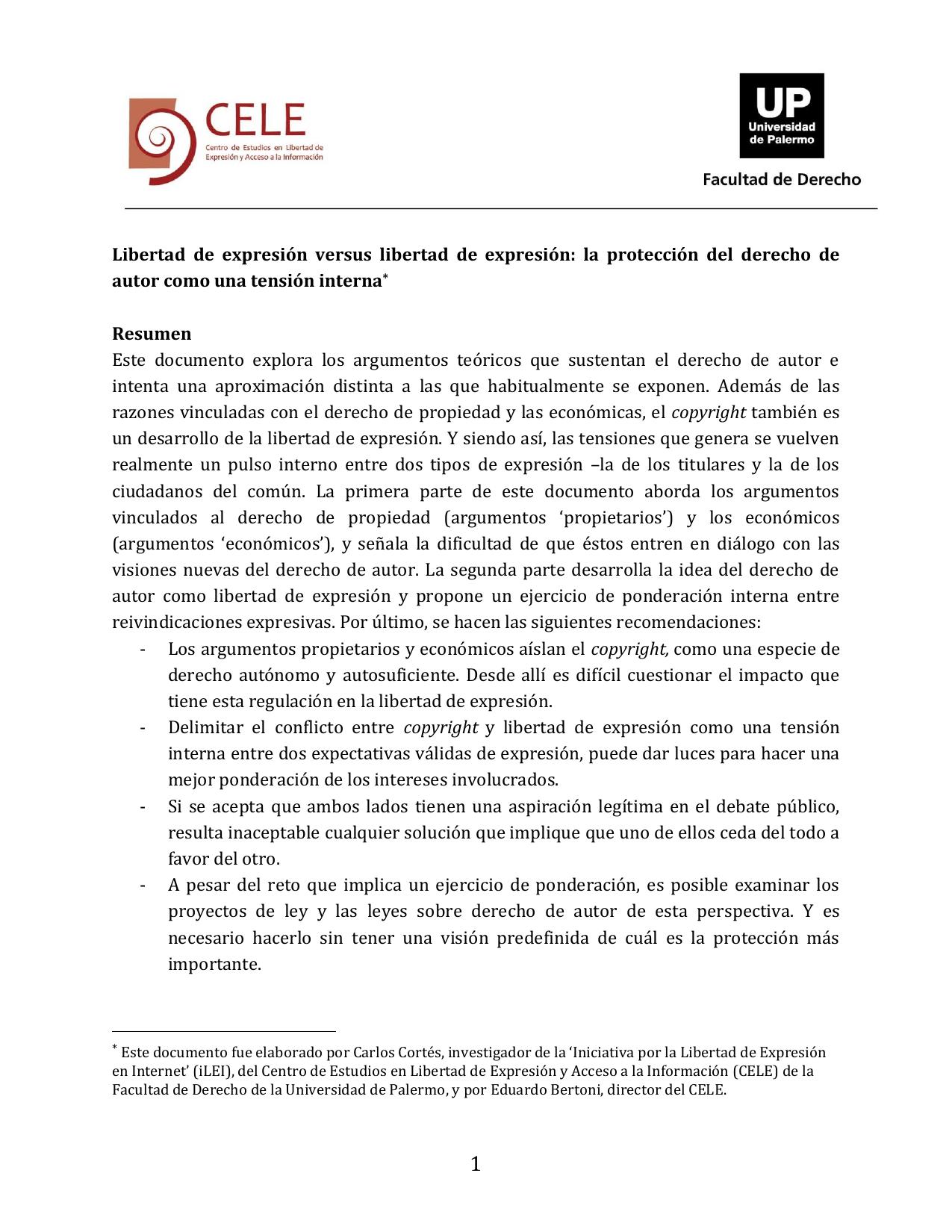
Freedom of Expression Versus Freedom of Speech: Copyright Protection as an Internal Tension
CELE Research Paper No. 17
Collaboration in ‘Cuadernillos de Temas Emergentes’ of the National Institute of Human Rights of Chile
Here, we present the work carried out by the Internet Freedom of Expression Initiative (iLEI), CELE’s special programme that aims to provide advice and technical support to Internet policy makers and advocates. Net neutrality, privacy, copyright, intermediary liability, and their relationship …
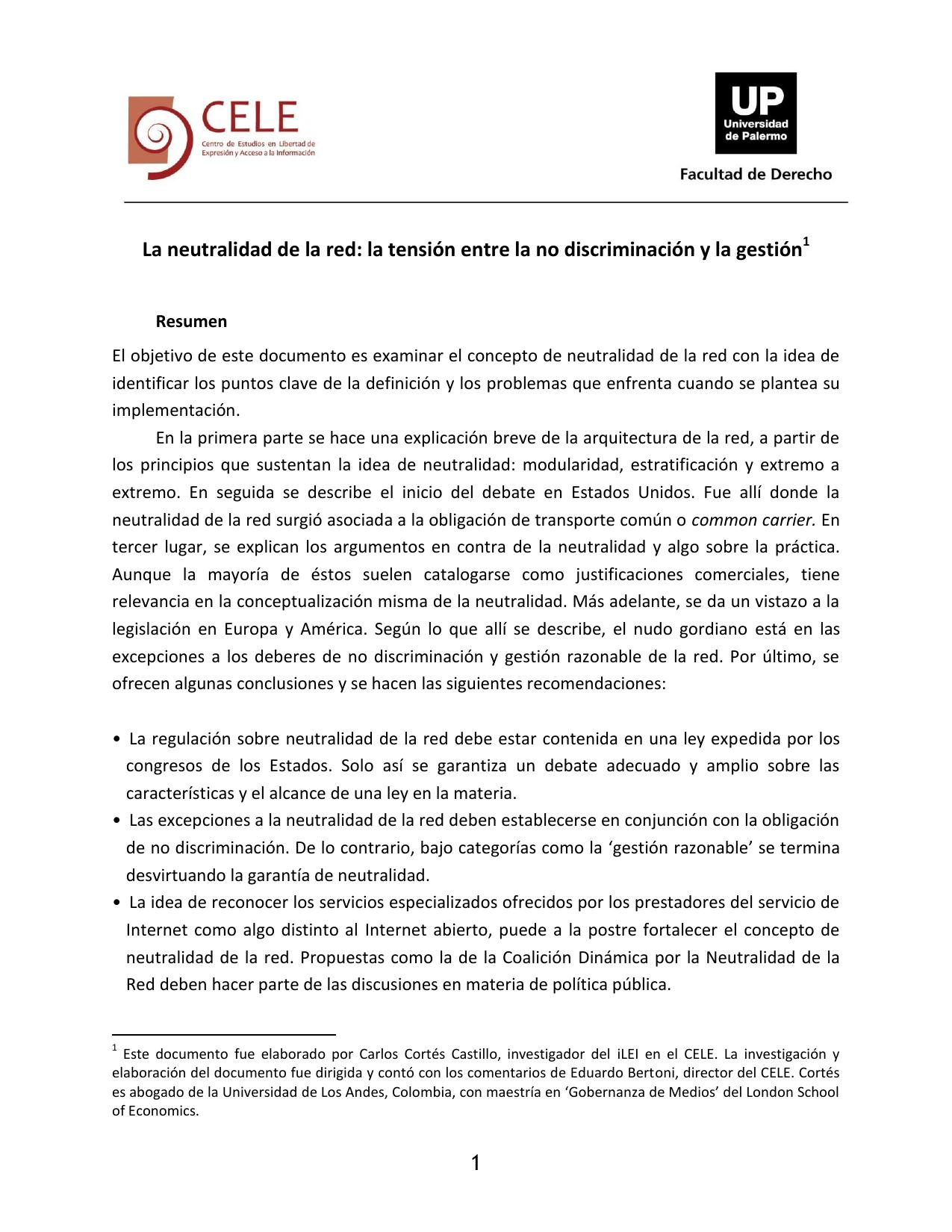
Net Neutrality: The Tension Between Non-Discrimination and Management
CELE Research Paper No. 16
The Housekeeper’s Keys: The Strategy of Internet Intermediaries and Its Impact on the Digital Environment
CELE Research Paper No. 14
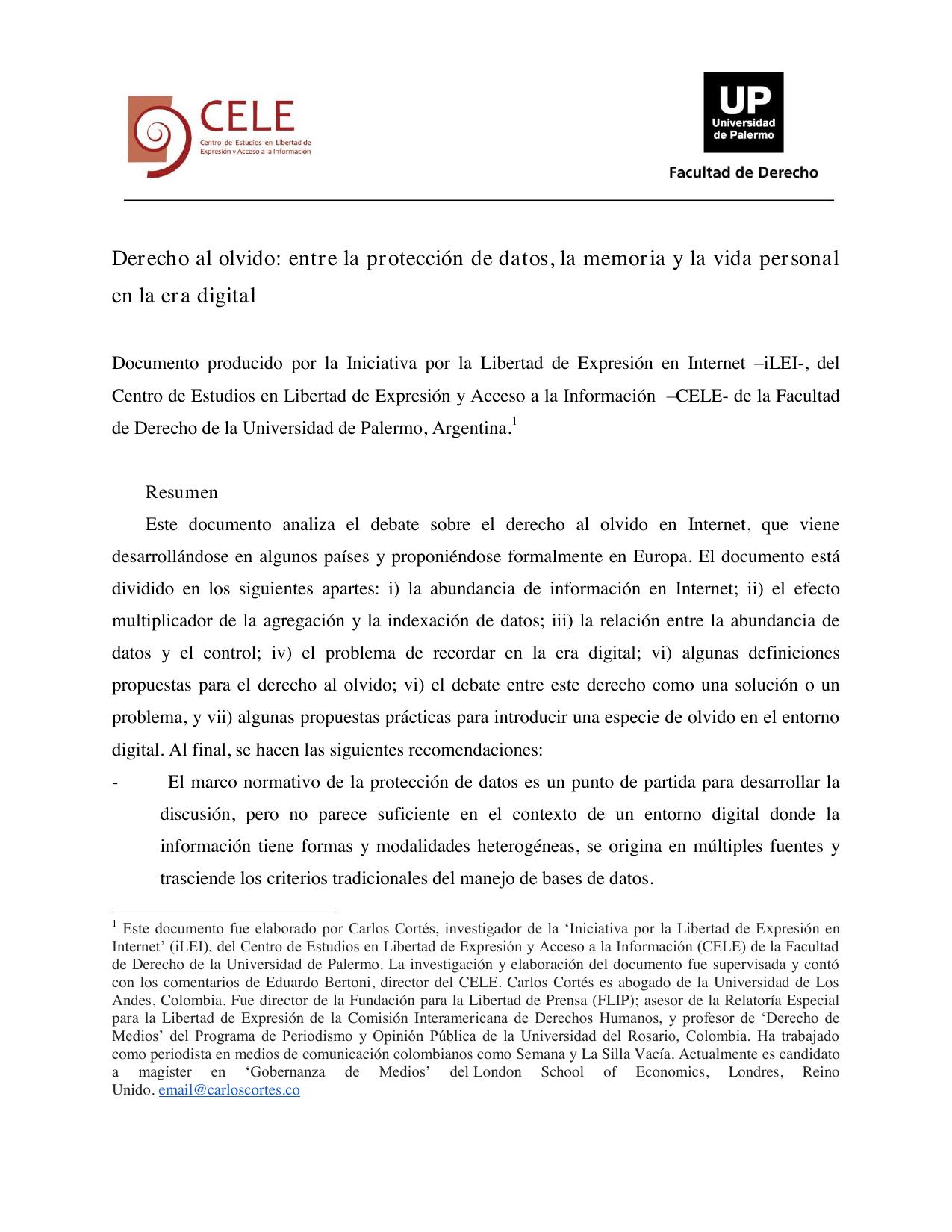
Right to be Forgotten: Between Data Protection, Memory, and Personal Life in the Digital Age
CELE Research Paper No. 12
Informe de UNESCO "Global survey on Internet privacy and freedom of expression"
Mendel Toby, Puddephatt Andrew, Wagner Ben, Hawtin Dixie, Torres Natalia, “Informe de UNESCO “Global survey on Internet privacy and freedom of expression””, Informe legislativo No. , Centro de Estudios en Libertad de Expresión (CELE), Buenos Aires (2012) PDF
Domain Names: An Expression Worth Protecting. Recommendations and Suggestions for Local Administrators in Latin America and Beyond
CELE Research Paper No. 10
Amicus curiae junto a Human Rights Watch ante la Corte Constitucional de Ecuador por el artículo sobre desacato del Código Penal ecuatoriano
CELE, “Amicus curiae junto a Human Rights Watch ante la Corte Constitucional de Ecuador por el artículo sobre desacato del Código Penal ecuatoriano”, Documento de posición No. 2, Centro de Estudios en Libertad de Expresión (CELE), Buenos Aires (2012) PDF
Access to Information and Personal Data: An Old Tension, New Challenges
Access to public information and the protection of personal data are two fundamental rights whose harmonization presents significant challenges in Latin America. This document, the result of the project Access to Information and Personal Data: An Old Tension, New Challenges, analyzes the …
Slander and Libel: Two Years After the Reform of the Argentine Penal Code
CELE Research Paper No. 9
Amicus curiae ante la Corte Constitucional de Colombia en el marco del proceso de revisión de la Ley 1520 (Ley Lleras)
Eduardo Bertoni, “Amicus curiae ante la Corte Constitucional de Colombia en el marco del proceso de revisión de la Ley 1520 (Ley Lleras)”, Documento de posición No. 1, Centro de Estudios en Libertad de Expresión (CELE), Buenos Aires (2012) PDF
Surveillance on the Web: What Does It Mean to Monitor and Detect Content Online?
CELE Research Paper No. 7
National Security and Access to Information in Latin America: State of Affairs and Challenges
CELE Research Paper No. 8
Decriminalization of Expression: The Argentine Experience
CELE Research Paper No. 6
Institutional Design and Effectiveness of the Agencies Responsible for Protecting Journalists and Investigating Crimes Against the Press: Mexico, Colombia and Guatemala
CELE Research Paper No. 5
Institutional Design and Effectiveness of Agencies Responsible for Protecting Journalists and Investigating Crimes Against the Press: Mexico, Colombia, and Guatemala
CELE Research Paper No. 5
Comentarios al anteproyecto de Ley de Transparencia Acceso a la Información pública y Buen Gobierno de España
OSCE, “Comentarios al anteproyecto de Ley de Transparencia Acceso a la Información pública y Buen Gobierno de España”, Informe legislativo No. , Centro de Estudios en Libertad de Expresión (CELE), Buenos Aires (2012) PDF
El CELE presenta recomendaciones para la Ley Modelo de Acceso a la Información en África
Eduardo Bertoni, “El CELE presenta recomendaciones para la Ley Modelo de Acceso a la Información en África”, Informe legislativo No. , Centro de Estudios en Libertad de Expresión (CELE), Buenos Aires (2011) PDF
Recomendaciones en base al tercer proyecto de dictamen elaborado por el senador Samuel Cabanchik a la Comisión de Asuntos Constitucionales del Honorable Senado de la Nación
Eduardo Bertoni, “Recomendaciones en base al tercer proyecto de dictamen elaborado por el senador Samuel Cabanchik a la Comisión de Asuntos Constitucionales del Honorable Senado de la Nación”, Informe legislativo No. , Centro de Estudios en Libertad de Expresión (CELE), Buenos Aires (2010) PDF
Apuntes para la presentación del profesor Eduardo Bertoni sobre el proyecto de ley de acceso a la información pública
Eduardo Bertoni, “Apuntes para la presentación del profesor Eduardo Bertoni sobre el proyecto de ley de acceso a la información pública”, Informe legislativo No. , Centro de Estudios en Libertad de Expresión (CELE), Buenos Aires (2010) PDF