
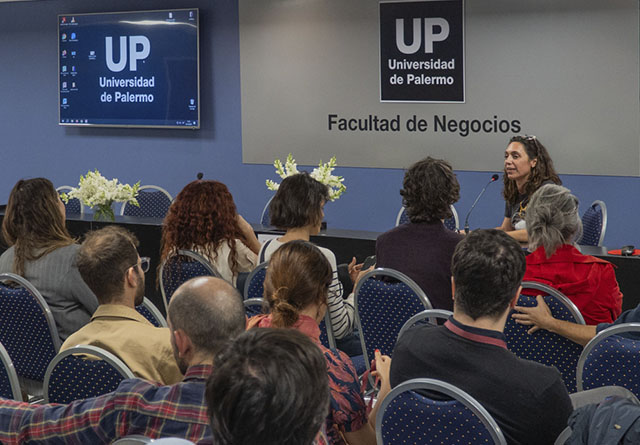
Preliminary program. Most activities will take place at Universidad de Palermo (J. A. Cabrera 3641, Buenos Aires). The program will be updated as speakers send in their reading materials.
Thursday, October 29
8.30–9 h
Registration (breakfast will be served)
9–9.30 h
Welcome and opening remarksAgustina Del Campo (CELE)9.30–11 h
Plenary session 1Protecting children in digital environmentsJavier Pallero (Independent), Veridiana Alimonti (EFF), Vladimir Cortés (Digital Action), María Capurro Robles (OBSERVACOM)
This plenary session addresses the fundamental tensions between age verification mechanisms in digital environments and the guarantee of key rights such as privacy, anonymity and free access to information. Through an interdisciplinary debate, the session seeks to analyze the regulatory and technical implications of measures to protect minors online from a human rights perspective, so that any restrictions do not disproportionately affect people’s digital rights.
Suggested reading
- Joint statement of security and privacy scientists and researchers on Age Assurance (here)
- Wikimedia: Online age verification explained (Part 1, Part 2, Part 3)
- EFF: Age Assurance Methods, explained (here)
- EFF: Zero Knowledge Proofs Alone Are Not a Digital ID Solution to Protecting User Privacy (here)
- United Nations (UN) Special Rapporteur on Freedom of Opinion and Expression, Organization for Security and Co-operation in Europe (OSCE) Representative on Freedom of the Media, Organization of American States (OAS) Special Rapporteur for Freedom of Expression and African Commission on Human and Peoples’ Rights (ACHPR) Special Rapporteur on Freedom of Expression and Access to Information: Joint Declaration on children’s right to freedom of expression and access to information in the digital age (link here)
- Office of the United Nations High Commissioner for Human Rights: Getting Children’s Safety Online Right (here)
- ISOC Chile: Análisis del proyecto de ley refundido sobre la protección de niñas, niños y adolescentes en los entornos digitales (here)
- Vladimir Cortés: Banning children from social media won’t make them safer online (here)
11–11.15 h
Coffee break
11.15–12.45 h
Track 1: RegulationThe impact of US AI industrial policy on digital rightsCarolina Botero (TTG Forum)
This session starts from a central question: how is US artificial intelligence industrial policy having an impact, and what can we learn from it to advance the digital rights agenda? Drawing on an analysis of the strategic documents of Donald Trump’s second administration, we propose a methodology to identify a relatively stable pattern of intervention that is replicated across different sectors.
During the session, participants will learn about this methodological proposal and test it by analyzing different sectors and cases. The goal is to identify how these public policy instruments are being used to spread technological standards and reorganize digital governance beyond traditional ICT-sector policies.
The session is conceived as an exercise in collective intelligence. Participants are invited to bring their research, national experiences and sectoral knowledge to contrast, complement and enrich the proposed methodology. Through that exchange we will seek to identify common patterns, differences between sectors and opportunities for advocacy. The ultimate purpose is to build a practical tool that helps civil society better understand how industrial, trade and geopolitical policy is shaping digital governance and, on that basis, identify concrete points of intervention to strengthen the digital rights agenda in a context where economic and industrial policy decisions are gaining weight relative to traditional human rights approaches.
Track 2: DemocracyInformation integrity. Perspectives from the Wikimedia modelPatricia Díaz Rubio (Wikimedia Chile), Evelin Heidel (Wikimedistas de Uruguay), Margarita Trovato (Wikimedia Argentina)
This session explores information integrity from the perspective of the Wikimedia ecosystem, looking at its role in the production, organization and circulation of free knowledge on matters of public interest. Through an introduction to the principles and governance that guide the collective construction of its projects, it will analyze the challenges this model faces in increasingly complex information contexts and in the age of artificial intelligence, presenting findings from research applied to regional cases such as political conflicts and extreme weather events.
Participants will get an introduction to the Wikimedia model and its role in today’s information ecosystem. They will be able to contribute perspectives from their own fields of work on current challenges around information integrity, enabling group reflection and the identification of opportunities to apply tools and approaches from this model in research, advocacy initiatives and open knowledge projects.
Suggested reading
- Wikimedia Argentina: Libertad de expresión, algoritmos y conocimiento colaborativo. Una alternativa desde el modelo Wikimedia (here)
Track 3: ViolenceMujeres Libres en Política. Digital gender-based violence in electoral contextsAgustina Brizio (Asuntos del Sur)
The session will begin by presenting the results of a study on information manipulation and digital political violence against women candidates for elected office in Latin America, carried out by Asuntos del Sur together with Fundación Multitudes based on the Argentine case.
Building on this diagnosis, the session seeks to open a space for discussion where attendees can share experiences from their own countries, and to share a replicable hybrid (forensic + qualitative) methodology for monitoring digital gender-based violence in electoral contexts. The goal is to foster a collective reflection that benefits the participating organizations and allows them to coordinate joint advocacy and observation strategies for the region’s upcoming elections.
12.45–13.45 h
Lunch
13.45–15.15 h
Track 1: RegulationIntermediary Liability in Brazil in 2026-2030: building workable governance parametersFrancisco Brito Cruz (Input Consulting)
Brazil is going through a decisive transition in its intermediary liability framework following the Federal Supreme Court’s ruling on the Marco Civil da Internet, the new executive decrees implementing it, and the new regulatory role of the Data Protection Authority (ANPD). This session seeks to create a space for collective reflection on how the practical implementation of these decisions is reshaping digital governance, addressing key concepts such as the duty of care, notice-and-takedown systems and safeguards against excessive content removal.
Through a participatory format, the session seeks to discuss parameters for reconciling the principle of legality, freedom of expression and transparency in the digital environment. It will encourage a collaborative dialogue to identify risks and good practices in the design of notice-and-takedown systems and the implementation of duties of care, compare experiences across countries, and outline a shared agenda of priorities for regulatory and institutional advocacy in the region.
Track 2: DemocracyContent Regulation in the Generative AI Era: Lessons on Safety, Fairness, and Access to Information from Brazil’s ElectionsHeloisa Massaro (InternetLab)
The session will begin by presenting the preliminary results of InternetLab research on the use and impact of generative artificial intelligence tools in Brazil’s 2026 general elections, prompted by the recent regulation of the Superior Electoral Court (TSE) that prohibits these tools from favoring or harming candidates.
We aim to spark a debate on the risks, strengths and weaknesses of regulatory approaches that seek to control what content AI can or cannot generate.
Track 3: ViolenceSLAPPs in Latin America: trends and new challengesSolciré Prevignano, Mariela Galeazzi (Amnesty International Argentina)
The session will begin by presenting evidence and patterns on the use of strategic lawsuits against public participation (SLAPPs) in the region —drawing on the work of Amnesty Argentina and adding R3D’s regional perspective— to analyze how the instrumentalization of the judicial system operates as a tool to harass and discipline journalists, activists and civil society organizations. Building on this diagnosis, it will examine recent trends and the responses courts have offered to the abusive use of the law.
The session is designed as a space for collective exchange to map the concrete impacts of abusive litigation in different Latin American contexts, bring forward successful experiences of procedural defense, and identify current challenges in protecting freedom of expression. Attendees will be invited to share trends and cases from their own countries to collectively move toward minimum criteria, procedural tools and advocacy initiatives capable of detecting and stopping SLAPPs early in the region.
15.15–16.30 h
Networking & Coffee
16.30–17 h
Welcome coffee, sponsored by Mercado Libre
17–18.30 h
Open eventE-commerce intermediaries: rethinking roles and responsibilitiesDan Nativ (Quien X Mi), Silvana Rivero (Maryva), Veridiana Alimonti (EFF). Moderator: Javier Pallero18.30–19 h
End of the day
19–20.15 h
Cocktail, sponsored by Mercado Libre (Verne Club, Medrano 1475)
Friday, October 30
8.30–9 h
Registration (breakfast will be served)
9–10.30 h
Track 1: RegulationThe “public health turn” in internet regulationRamiro Álvarez Ugarte (CELE)
In recent years we have seen, around the world, a series of regulatory initiatives that approach technology much as we approach cigarettes: as something harmful and risky, to be discouraged among adults and banned for children and adolescents. This regulatory trend is global: an ongoing CELE research project had identified —by late July 2026— 77 laws and bills worldwide that seek to ban social media for minors, establish mandatory age verification systems, or ban certain design features in certain services, among other measures. Taken together, they amount to a “public health turn” toward technology that we think is worth discussing. What is driving the trend? Are the legal mechanisms being used the right ones? What do historical precedents tell us? What do we do with the necessarily ambiguous nature of technology, which is not present in, e.g., drugs or alcohol? What kind of constitutional review do these laws deserve? Which ones fare well and which fare badly in that exercise? The session seeks to raise these and other questions to generate a useful discussion about a trend that has already reached Latin America.
Track 2: DemocracyMy privacy is my vote. Personal data protection as a path to strengthening the integrity of electoral processes in Latin AmericaAgneris Sampieri (Access Now)
The session will begin by presenting the regional project Mi Privacidad es mi Voto (My Privacy is my Vote), developed by Access Now together with organizations from Colombia, Peru and Brazil (to date). The initiative proposes a pragmatic approach to disinformation and political microtargeting: instead of focusing on content moderation —which creates risks of censorship— it proposes strengthening personal data protection mechanisms and privacy-oriented technological design as key tools for electoral integrity.
Building on this framework and the regional recommendations developed, the session is designed as a collaborative workspace to subject the proposals to critical scrutiny. Attendees will be invited to assess the feasibility of adopting these measures in their countries, analyze post-electoral implementation strategies and identify partnerships to adapt the methodology to future electoral processes in the region and globally toward 2027.
Suggested reading
- AccessNow: Mi Privacidad es mi Voto: Fortaleciendo la integridad informativa en América Latina (here)
Track 3: ViolenceWho oversees automated moderation systems? Meta’s Oversight Board, freedom of expression and human rights in Latin AmericaJavier Gallegos Gambino (Confianza Digital), Patricia Díaz Rubio (Wikimedia Chile)
The overall goal of the session is to analyze the role of Meta’s Oversight Board with regard to automated content moderation on social media, with particular attention to its scope and limits in protecting freedom of expression and human rights in Latin America. Drawing on relevant Oversight Board decisions, it proposes to analyze how automated moderation systems affect freedom of expression and other human rights in Latin America. The discussion will pay special attention to cases involving political speech, social protest, journalism, violence, disinformation, satire, human rights advocacy, and electoral contexts or democratic crises.
The session seeks to discuss a concrete question: can a private mechanism like the Oversight Board offer sufficient guarantees against the errors and biases of automated moderation, or are broader forms of transparency, accountability and external oversight compatible with human rights required?
The session will use a participatory fishbowl format, inviting attendees to join the discussion table directly. The goal is to collectively build a space for exchange to map regional cases of harm caused by automated moderation, assess standards of transparency and due process, and define minimum guarantees to demand greater accountability from large digital platforms.
Suggested reading
- Evelyn Douek: The Meta Oversight Board and the Empty Promise of Legitimacy (here)
10.30–10.45 h
Coffee break
10.45–12.15 h
Track 1: RegulationForgetting the right to be forgottenDilmar Villena (Hiperderecho)
The session will begin by analyzing a recent ruling by Peru’s Constitutional Court that ordered a news outlet to delete three entire news stories by invoking the “right to be forgotten”, a precedent that shows the tendency of courts in the region to shift this burden onto local media given the difficulty of litigating against transnational platforms. It will examine how this application of the European standard on search engines threatens the preservation of news archives, leaves historical memory unprotected and works as a form of subsequent censorship contrary to inter-American standards on freedom of expression.
Building on this case, the session proposes to open a regional discussion to assess whether this distortion is replicated in other Latin American countries and to map their common risk points. Attendees will be invited to discuss proportionality criteria (such as de-indexing versus content removal) and explore tools for strategic litigation, advocacy and the preservation of digital memory in the face of this growing threat.
Suggested reading
- Dilmar Villena: Olvidemos el derecho al olvido: censura en Internet, autoritarismos y amenaza a la memoria (here)
Track 3: ViolenceDigital gender-based violence against women in public lifeAlejandro Dulitzky (Alianza Regional por la Libre Expresión e Información), UN Women; Heidy Gordillo (Equality Now), Articulación de la Sociedad Civil en Seguimiento a la Convención de Belém do Pará
The conversation will address how different forms of violence in digital environments affect public and political participation, freedom of expression, representation, access to public debate and the conditions for exercising democracy. The dialogue will connect these harms with current challenges in digital ecosystems, including the conduct of platforms, content moderation, artificial intelligence, information manipulation and electoral processes.
Suggested reading
- Alianza Regional por la Libre Expresión e Información and UN Women: Violencia digital contra mujeres periodistas y activistas en América Latina (working paper in progress)
- Articulación de la Sociedad Civil en Seguimiento a la Convención de Belém do Pará. (2026). Posicionamiento común de la sociedad civil frente a la violencia de género facilitada por tecnologías (working paper).
- Articulación de la Sociedad Civil en Seguimiento a la Convención de Belém do Pará. (2026). Puntos de partida para orientar leyes y políticas frente a la violencia digital contra las mujeres basada en género (working paper)
12.15–13.45 h
Track 1: RegulationFreedom of opinion in the algorithmic ageChantal Joris (Article 19), Vladimir Garay (CELE)
Recent debates on the impact of artificial intelligence on the generation, dissemination and consumption of information, and on the implications of these developments for human rights, have revived the discussion about the nature and content of freedom of opinion and how it can be applied in relation to modern technologies. At a time when generative AI is becoming one of the main sources of information, there are growing concerns about how it could interfere with people’s autonomy.
Historically, however, the right to freedom of opinion has received little development. What exactly does it protect, and how is that right exercised in the context of generative AI? This workshop session seeks to jointly explore the scope, content and implications of the right to freedom of opinion through a collective discussion of its main dimensions. It will also address the relationship and boundaries between freedom of opinion and other closely related rights, in particular freedom of expression, dignity, privacy and freedom of thought and religion.
Track 2: DemocracyTechnologies that enable democracyJuan Martín Marinangeli (Asuntos del Sur)
The session will begin by presenting a regional mapping of critical and alternative technologies for the defense of democracy, built collectively with digital rights organizations in Latin America, and a proposal to add a technological dimension to the Democratic Erosion Markers (MED) methodology.
The session seeks to lay the methodological groundwork for adding a technological dimension to the MED framework, testing its methodology with international digital rights experts, and building bridges between this line of work and organizations that have not been involved in it so far, with the aim of taking a first step toward systematizing how certain technologies drive democratic erosion globally.
Since the mapping is a work in progress, the session will function as a space for consultation and collective validation: participants will be invited to contribute cases, alternative technologies or critiques of the proposed framework, and to point out gaps or organizations that should join the process.
Track 3: ViolenceIntegrating a gender perspective into cybersecurity policyVerónica Ferrari (APC)
The session will begin by presenting a preliminary version of the guide developed by APC to integrate a gender perspective into the design, implementation and evaluation of national cybersecurity strategies. It will address how neutral approaches tend to overlook critical vulnerabilities in technological systems, and how including an intersectional approach in their design and evaluation strengthens cybersecurity policies.
The session aims to gather feedback to inform the final version of the guide and strengthen its practical application in the region. Attendees will be invited to share the challenges they face when applying this approach in their contexts, identify gaps in the current agenda and discuss advocacy tools so that civil society can demand more inclusive cybersecurity policies that respect human rights.
Suggested reading
13.45–14.45 h
Lunch
14.45–16.15 h
Plenary session 2Artificial intelligence regulation in Latin AmericaDerechos Digitales, Fundación Karisma, Hiperderecho, InternetLab; IPPDH MERCOSUR
The law that never was: a diagnosis of regulatory paralysis on AI in the region and its causes — Derechos Digitales, Fundación Karisma, Hiperderecho, InternetLab.
The session will present the state of artificial intelligence regulation in Latin America, marked by paralysis in the passage of comprehensive laws and a parallel tendency toward partial punitive reforms. It will analyze the geopolitical, economic and social pressures that explain this uneven landscape, detailing the specific dynamics and regulatory gaps observed in cases such as Brazil, Colombia and Peru. Drawing on this empirical evidence, participants will discuss the causes of this slowdown and its impact on human rights protection, as well as regulatory and public policy alternatives that go beyond purely criminal or restrictive approaches, steering the regional debate toward effective safeguards for the development and deployment of AI.
Presentation of the MERCOSUR Declaration on Human Rights Principles in the Field of Artificial Intelligence — IPPDH MERCOSUR.
16.15–16.30 h
Coffee break
16.30–18 h
Track 1: RegulationShared vision or paper consensus? Taking stock of an attempt to reimagine the Internet in Latin AmericaCoordinators: Veridiana Alimonti (EFF), Ramiro Álvarez Ugarte (CELE), Javier Pallero (Independent)
The session seeks to open a space for a collective retrospective that lets us assess how far we have come in the discussion process of the “Navigating the Dystopia” group, which held —at the 2025 Workshop— a Day Zero where we imagined a course of action that lost momentum as the months went by. The goal of this session is to decide, pragmatically, what comes next for this effort: do we recognize that it was a valuable intellectual exercise that concludes with a document that will remain as an “academic” reference, or is there still the will, the appetite and the real capacity to turn it into a political drive and joint action for the region?
To that end, we propose a discussion organized around the following objectives: 1. Analyze whether and how the effort served as a meeting point to map reflections, work through disagreements and capture a snapshot of the state of affairs in the region during 2025-2026 (or part of that period). 2. Determine what lessons this experience leaves us (what worked and what failed) in trying to produce shared visions, strategies or roadmaps that gather common minimums to advance work on digital rights in Latin America. 3. Decide collectively whether the cycle of this exercise has definitively come to an end or whether, on the contrary, there is an appetite to turn it into a living political compass oriented toward concrete, jointly agreed actions.
Track 2: DemocracyA digital playbook against authoritarianismMariví Marín (ProBox Venezuela)
The session will begin by analyzing how different governments in the region —such as Venezuela, El Salvador and Mexico— have, through legislative reforms, digital surveillance, internet shutdowns and content moderation, consolidated a “playbook” of technological and legal tools to shape and control the digital space. It will examine the common patterns behind these measures, which, under narratives of security or the fight against disinformation, end up severely restricting freedom of expression, privacy and public debate.
The session is designed as a participatory space focused on systematizing good practices, lessons learned and resistance strategies developed by civil society. Attendees will be invited to share experiences from their own countries to enrich this collective diagnosis, identify synergies and build common operational tools to confront repressive dynamics and promote a model of digital governance that respects human rights in Latin America.
Track 3: ViolenceTechnology-facilitated gender-based violence: the differentiated impact on girls and adolescentsLucila Galkin, Lucía Altamirano (Amnesty International Argentina)
The session will begin by addressing the central paradox of digital gender-based violence affecting children and adolescents: while forms such as harassment, non-consensual sharing of images or sexual deepfakes push young people out of the digital space, the most common institutional responses —punitive, adult-centric, prohibitive or overprotective— end up having the same restrictive effect on their freedom of expression and evolving autonomy. It will examine the responsibilities of platforms and state frameworks (or the lack thereof) to offer cross-sector responses that prevent and remedy violence without resorting to censorship or exclusion.
Building on this diagnosis and drawing on the guides and guidelines developed by Amnesty International together with UNFPA, the session is designed as a space for consultation and collective construction. Participants —experts in digital rights, gender, education and justice— will be invited to discuss prevention and support tools, assess applicable freedom of expression standards and define minimum consensus to guide regulations and public policies that ensure safe digital environments for adolescents in the region.
Suggested reading
- UNFPA, Amnistía Internacional Argentina, ONU Mujeres: Hackeá la violencia digital. Sistematización, estrategias y recomendaciones para combatir la violencia basada en género facilitada por las tecnologías y crear espacios digitales seguros (here)
18–18.15 h
Closing remarksAgustina Del Campo (CELE)