
TikTok got serious! A new form of protest
Over the past few weeks, we have witnessed massive protests by the Black Lives Matter movement, which have led hundreds of thousands of people in the United States and around the world to demonstrate against racism
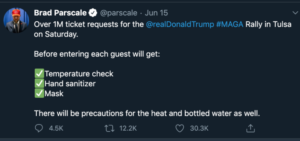
Over the past few weeks, we have witnessed massive protests by the Black Lives Matter movement, which brought hundreds of thousands of people in the United States and around the world out onto the streets to demonstrate against racism. Social media was no exception—it was a venue for both the protests and the reactions to them. In fact, in the midst of this crisis, U.S. President Donald Trump lashed out at social media (see more here and here) in an effort to regulate companies’ conduct regarding third-party speech. As if that weren’t enough, all of this is unfolding against the backdrop of a highly polarized election campaign leading up to the November presidential election. While it’s no surprise that Facebook and Twitter are key players, TikTok has also taken center stage in recent weeks—some might say, surprisingly. TikTok is a Chinese social media platform that allows users to easily upload and edit videos, adding music and various effects. Since its launch in 2016, it has taken the world by storm among teenagers, with more than two billion (yes, two billion) global downloads. Despite its popularity, it wasn’t known as a platform where users discussed politics, much less organized social movements… until now. Over the past few weeks, amid a social climate in turmoil, Trump and his team promoted their rally in Tulsa, Oklahoma, without imagining that thousands of teenagers—especially K-pop fans—would boycott the event. How did they do it? Through TikTok: videos circulated calling on users to register for the rally—only to not show up. (https://www.nytimes.com/2020/06/21/style/tiktok-trump-rally-tulsa.html) Days before the rally, which took place on Saturday, June 20, Brad Parscale, Trump’s campaign manager, boasted that more than 1 million people had registered to attend the event, which had a maximum capacity of around 20,000 people. When Saturday arrived, turnout was so low that they even had to cancel planned outdoor activities, having anticipated a crowd that never materialized. Hundreds of thousands of TikTok users took credit for part of the event’s failure. 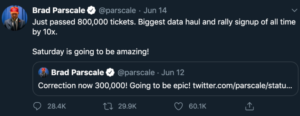
 This is not the first time that K-pop fans have organized and become involved in social and political issues using social media. In late May, the Dallas, Texas, police department called on citizens to share videos of “illegal activities” during the Black Lives Matter protests via an app called iWatch Dallas, managed by the local police.
 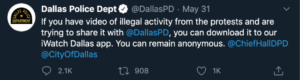 The tweet caught the attention of K-pop fans, who began sharing clips from music videos on the app with the intention of sabotaging it, to the point of causing it to crash. A few hours after the original tweet, the Dallas Police Department announced that the app had been temporarily taken offline due to technical issues. More recently, a call for users to visit Donald Trump’s official website, add as many merchandise items as possible to their “shopping cart,” and then not buy them. This causes the site to automatically redirect ads to users who left their purchases incomplete. What’s the goal of this strategy? To deplete the Trump presidential campaign’s digital advertising budget. The numbers speak for themselves: the original video was viewed by 2.9 million users, and around 40,000 users shared it on their accounts. Undoubtedly, even though they were not specifically designed for these purposes, platforms like TikTok represent new spaces for political expression and—why not?—protest. In times of social distancing and bans on demonstrations and counter-demonstrations, these forms of online political participation once again bring to the forefront questions that, despite not being necessarily new, remain unresolved in global jurisprudence. If we look back at the history of online protests, we can see that they have existed since before the rise of social media. Some of them took the form of Distributed Denial of Service, or “DDoS”, for example—the quintessential modus operandi of the activist (“hacktivist”) group Anonymous in 2010, directed against giants such as PayPal, Mastercard, and Visa, among others. These attacks were part of the so-called “Operation Payback”, prompted by the financial companies’ decision to block donations to the Wikileaks website. Around 10,000 people participated in the DDoS attacks, which caused the financial giants’ websites to go offline temporarily for several hours. Operation Payback sparked a debate that is now taking on fundamental importance: was it hacking or was it a form of expression? Today, DDoS attacks are illegal in several countries around the world, including the United States and Great Britain. In the latter, a group of young people was convicted for Operation Payback, two of whom served sentences of up to 18 months in prison. One of the judges who convicted them argued in his ruling that “it is intolerable that when an individual or a group disagrees with the activities of a particular entity, they should be free to restrict that activity through attacks such as those that took place in this case.” But there are also those who question coordinated strategies on social media—not because they involve DDoS attacks or even because they are incompatible with freedom of expression, but because of what this coordinated action has meant for the landscape of so-called “fake news.” In an interesting article in the Washington Post, Molly Roberts, a technology and society reporter, argues that “celebrating some forms of manipulation while condemning others is an unsustainable tactic for anyone who wants to untangle our global web of lies. “It’s sad that this is the kind of activism that feels most normal and natural to those who grew up in the Internet age; sad that many believe it’s the activism most likely to succeed on a battlefield already filled with falsehoods; and, even sadder, that they might be right.” On the other side of the argument, there are those who view DDoS attacks and this type of organized behavior as a form of protest and argue that, as such, it should be protected as a legitimate exercise of free speech. There are even those who go further and believe that these types of protests should be encouraged, opening the door to new forms of expression (as stated by the renowned defense attorney for digital activists and hackers, Jay Leiderman, in this article). The lack of consensus on how to handle these demonstrations is particularly relevant in today’s internet ecosystem, where platforms are increasingly under pressure to adopt content moderation measures. Facebook, for example, is fighting against “coordinated inauthentic behavior,” understood as behavior carried out by users with fake identities. What sets the recent events on TikTok apart, however, is that this behavior was promoted by real, or “authentic,” users. There are legal tools for analyzing this behavior within the framework of the rights to freedom of expression, the rights of association and assembly, and the rights to political participation. Regardless of the outcome in specific cases, these systems provide a framework for analyzing such conduct that warrants consideration. Among the key standards for protecting these rights, it is noteworthy that any measure seeking to restrict them must be established in advance by law, as well as being necessary and proportionate to the legitimate aim pursued—whether that be ensuring respect for the rights of others or protecting national security, public order, or public health and morals (see Articles 13, 15, and 16 of the American Convention, and Articles IV, XXI, and XXII of the Declaration American Declaration of the Rights and Duties of Man, within the inter-American system). Various international experts have also contributed to interpreting what constitutes peaceful protest and what does not. Among others, the reports of the UN Special Rapporteur on the Rights to Freedom of Peaceful Assembly and Association are noteworthy (see reports from 2012 and 2015) and, more recently, the report “Protest and Human Rights” by the Special Rapporteur on Freedom of Expression of the Inter-American Commission on Human Rights, from 2019. Twenty years have passed since the first DDoS attacks, and we can observe how forms of digital association and activism have evolved—not only in terms of their nature, scale, and scope but also in terms of the actors involved. Perhaps the most important thing at this juncture is to go back to basics and not lose sight of the analytical framework through which to address these new manifestations. By Morena Schatzky Image credit: Kon Karampelas @konkarampelas