
Putting it in context: Zuckerberg’s publishing company, the Twitter-Trump conflict, and the responsibility of intermediaries in the face of long-standing social problems
On Thursday, June 18, the Clarín newspaper republished an editorial by Mark Zuckerberghttps://www.clarin.com/opinion/facebook-alentara-voto-participacion-diversidad-voces-elecciones-ee-uu-07zYD2-ubr.html, founder and CEO of F
On Thursday, June 18, the Clarín newspaper republished an op-ed by Mark Zuckerberg, founder and CEO of Facebook, originally published in USA Today the previous day, regarding measures taken by the company ahead of the upcoming U.S. presidential election. The editorial announced the creation of a space dedicated to political and election-related information on the Facebook and Instagram platforms, aimed at promoting better access to information and combating misinformation during election periods; and it commits to promoting and encouraging political participation as part of the company’s civic responsibility, in an effort to combat efforts aimed at voter suppression—a current debate in the U.S. from which Zuckerberg has not been exempt. These measures are not the first the company has taken regarding elections or misinformation; however, they come amid a complex context for major social media platforms—particularly Facebook and Twitter—which have faced severe criticism for irregularities in the enforcement of their community standards and their policies regarding content or statements by politicians. On May 26, 2020, U.S. President Donald Trump used his Twitter and Facebook accounts to tell his supporters that voting by mail would be fraudulent. He claimed that ballot boxes could be stolen, fake ballots could be printed, and even signatures could be forged. Many users and NGOs criticized this type of content, accusing it of being part of efforts to suppress voting among certain sectors and of casting a cloud of doubt and uncertainty over the integrity of the electoral process from the outset. In a radical policy shift, Twitter decided to have fact-checkers review this content. As a result, a fact-check label was applied to the tweet. Twitter determined that President Trump’s claim had no factual basis and therefore also provided links to resources for further information on the topic. This was the first time Twitter applied a fact-check and a fact-check label to a post made by the U.S. President. It is not the first time, however, that the company has taken action against content created and disseminated by public officials—and even presidents of other countries—but it is the first time it has done so regarding content from the U.S. President, whose headquarters, coincidentally, are located there. 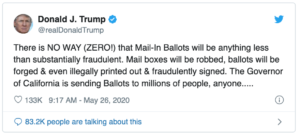 Facebook, on the other hand, chose not to submit the post to its fact-checkers, arguing that when it comes to political expression, the company should not act as an arbiter of truth. The differing positions of the two companies are thus laid bare. At the same time, the tragic murder of George Floyd occurred, sparking public outrage, laying bare the inequalities and systematic discrimination that exist in the U.S. against the Black community, and triggering intense protests across the country and eventually around the world. Some of these protests led to looting, destruction of property, and violence. Faced with this situation, the President of the United States once again turned to his Twitter and Facebook accounts to warn the people of Minneapolis that if the state government failed to contain the situation, he would send in the National Guard. He concluded his statement with a particularly problematic phrase: “When looting starts, shooting starts.” The phrase is believed to have been taken from the Miami police chief, who in 1967 promised violent reprisals against those who protested the “stop-and-frisk” policies. Twitter determined that the President’s statements constituted incitement to violence, which violates Twitter’s terms and conditions of service, but that there was a journalistic interest in these statements because they came from the President of the United States. Consequently, it hid the content behind a warning that summarized the above. Zuckerberg, on the other hand, determined that the content in question was political in nature and that there was a general public interest in ensuring that such content was not hidden or blocked; he therefore chose to leave it on his platform as is, without any warning. Facebook publicly maintains that political speech—particularly that of public officials—is subject to high levels of scrutiny and is in the public interest. This argument aligns with what the company has been stating for months regarding political content, which, in theory, is exempt from external fact-checking and is generally considered to be of sufficient journalistic interest to be left up even if it violates its Community Standards. Criticism was once again swift to follow, even from within the company and among its own employees. Amid these discussions—which are nothing more than anecdotal, despite having already sparked reactions from the government and society—a fundamental question arises: How should these companies handle statements made by public officials on social media? What role do we, as citizens and users, want these platforms to play in our election campaigns? Or in the management of our emergencies? Or in our democracies in general? These are the questions that, despite the many revisions to terms and conditions of service and the numerous measures attempted, remain relevant and await a definitive answer. The measures announced by Zuckerberg this week are part of this broader and more fundamental debate. And unfortunately, while this commitment is a step in the right direction, it does not resolve these more structural issues. Just to give one example, on June 18, The Verge reported that Facebook removed nearly 80 paid ads from Trump from the platform because they contained images of an inverted triangle—a symbol used to identify political dissidents in Nazi concentration camps. And once again, we return to the fundamental question. It is imperative to clarify the criteria these companies—which have billions of users worldwide—apply to the speech of public officials on matters of public interest, and to provide even greater transparency regarding the implementation of community guidelines or terms and conditions of service. It is also urgent to clarify what we, as users—but above all as citizens—want these platforms to do with this type of content. It is urgent to promote a broad and informed debate on the repercussions these decisions have on our political systems and our democracies. This is the best contribution we can make to promote democracy, not only in the United States but globally. By Agustina Del Campo twitter.com/@agustinadelcamp