
CFK vs. GOOGLE: Theoretically interesting, but in reality mundane
Last week, I was involved in several discussions regarding the motion for early discovery filed by and granted to Cristina Fernández de Kirchner (CFK) against Google LLC. Perhaps the most interesting aspect of this exchange was
Last week, I was involved in several discussions regarding the motion for early discovery filed by and granted to Cristina Fernández de Kirchner (CFK) against Google LLC. Perhaps the most interesting aspect of this exchange was the sheer number of theories, arguments, and hypotheses regarding the applicable legal framework, the nature of the speech, or its authorship—since the truth is that the speech in question is quite common, run-of-the-mill, and even ordinary. Personally, as I have argued in other forums, I believe the case boils down to a public official complaining about alleged slander and libel. This last part, in my view, is not at all interesting. The theoretical analysis of the case—unlike the expression itself—arouses great interest because it takes place within a context in which the economic power of internet service providers, such as Google, has grown enormously. The technology they use for indexing and curating the information they host, organize, and display has grown exponentially and become increasingly sophisticated. The algorithmic systems of many of these companies—namely social media platforms and search engines—have now completely undermined the argument that content monitoring is impossible or impractical—an argument that was valid in 2014 when the Supreme Court of Justice of Argentina (CSJN) ruled Belen Rodríguez (Decisions 337:1174)—and have raised new and important questions. Many argue that if these companies can process or monitor all content on their networks for commercial reasons or to enforce their terms and conditions of service, why not do so to control the circulation of illegal speech? This has been a recurring question in Europe in recent months, where proposals such as the German NetzDG, or the proposal debated in the United Kingdom regarding “duty of care”. Perhaps what I would emphasize in this regard is that the question to be resolved should not be whether permanent monitoring of social media for law enforcement purposes is possible, but rather whether it is desirable from the perspective of the right to freedom of expression and due process. We can, of course, debate whether the private monitoring conducted by companies is desirable or not as well, but that is another conversation. Given the complexity of the issue, these lines aim to make a modest contribution toward framing this case from a legal perspective.
What happened? For a few hours on May 17, 2020, Google’s “Knowledge Panel”—the information the search engine displays about certain individuals or entities of particular notoriety—showed the following information:
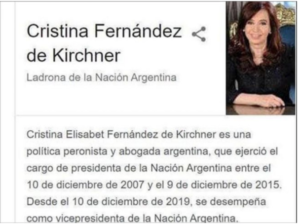 In this headline, beneath the vice president’s name—where her title or profession is usually listed—the caption “Thief of the Argentine Nation” appeared, as if that were her official title.
Regarding the disputed expression: The expression refers to harmful conduct. It could well be understood as an opinion or a factual accusation. Within the framework of the Inter-American Human Rights System and our constitutional framework, this distinction matters. Opinions are unverifiable and, in principle, do not give rise to further liability. Factual assertions may constitute infringements on the rights of third parties and are subject to verification and proof; therefore, anyone who makes a false statement about a third party could, in principle, be subject to subsequent liability (never prior liability, as that would constitute prior censorship) for the harm caused. How can we determine in this case whether this constitutes an opinion or a factual assertion? In many cases, people debate, discuss, and exchange opinions, and it is the context that determines whether the expression can be characterized as an opinion or a fact. When the opinion concerns public officials in the exercise of their duties, such statements enjoy even greater protection (Inter-American Court of Human Rights, Kimel v. Argentina Para. 93). The authorship and the context in which the statements are made are of fundamental importance when characterizing them. It is clear that the title “Thief of the Nation” is neither a professional nor an academic title, nor is it a position of any kind. This expression would hardly confuse any reader as to whether it is true or false. From this perspective, the expression could also be characterized as satirical. This type of humor typically relies on the dissonance between the context and the literal expression. (See SCILJ, Just a Joke: Defamatory Humor and Incongruity’s Promise, 2011). Applied to our case study, determining whether this expression indeed belongs to the satirical genre will be closely linked to determining authorship. It is clear that Google’s knowledge panels are not forums for humor or for sharing content. And Google itself defines them as informational panels about individuals or legal entities. If we consider that the expression was authored by a third party and that the search engine merely linked to information generated by third parties—in this case, Wikipedia—the “trolling” (as Ramiro Álvarez Ugarte puts it) or the Wikipedia vandalism—to make it appear in Google’s featured snippet could very well be considered a satirical device. It could even be seen as a form of protest—a concept that is often closely linked to humor (See here). If, on the other hand, we consider Google to be the author of this expression, the argument is unlikely to hold up, and we would then have to proceed with an analysis of the other elements that constitute civil liability for defamation.
About the author: Intuitively, when Google is involved in a lawsuit, one tends to think that the basis for attributing liability is that typically applied to intermediaries regarding third-party content. The motion for discovery filed by CFK challenged this logic, arguing that in this case, liability is not being attributed based on the links the search engine provides to other information or sources, but rather that Google is considered the AUTHOR of the defamatory statements. Google explains on its website that knowledge panels are:
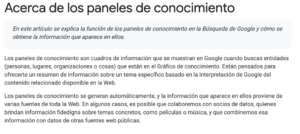 And it explains in a link that “a featured snippet includes the following: information cited from a third-party website; a link to the page; the page title; the page URL” (emphasis added). From Google’s definition of the Knowledge Panel, it is not clear, however, whether these panels are limited to reproducing third-party information and linking to it, or whether the company algorithmically generates content different from the source material, or whether it generates a summary of multiple sites—which would be a middle ground between the first and second options. This is no minor point and has sparked heated discussions on social media. Those who disseminate third-party information and ideas are not liable for them as long as the information is attributed and has not been substantially modified (e.g., CSJN, Sujarchuck v. Warley, 2013 Rulings: 308:789). Case law regarding the liability of online intermediaries points in the same direction, as seen in the aforementioned Belén Rodríguez case. If these were “summaries”—the third option—the characterization could lean one way or the other. U.S. courts in some of those cases held that even in instances where there are minor modifications to third-party content, such content is protected under that country’s online intermediary liability law. (See Roca Labs, Inc. v. Consumer Opinion Corp., 2015 WL 8387974 (M.D. Fla. Dec. 10, 2015—via Eric Goldman). If Google were considered the author of the expression, the standard analysis for libel and slander regarding authors would apply, and in any case, intent or negligence and damages would have to be proven. And in this case, it would be necessary to determine whether the restriction on Google’s freedom of expression is necessary and proportionate in a democratic society, given that CFK is a very high-ranking public official and her tolerance threshold for criticism must be higher than that of the general public. If we follow this line of reasoning, more complex and interesting questions arise: When can an algorithmic result be considered a new work? When the algorithm generates new, original content, who is liable? And what is the basis for attribution? In this case, the determination will likely depend on the information Google provides in response to the request for evidence, as well as on the legal arguments it presents in this regard. CFK’s request for evidence includes a point to this effect, asking “for a clear and precise explanation of how the information is generated.” (Page 8, point i).
On the applicability of consumer law (Law 24,240): The request for preliminary evidence falls within the framework of a potential lawsuit for violation of consumer rights. It is established that CFK has been a user of Google’s search engines since 2011 to argue that “a company with which she has a long-standing contractual relationship has breached the consumer contract and directly attacked her person, tarnishing her name and honor, and brutally damaging her image.” While many of the discussions regarding the liability of intermediaries for the design and implementation of their terms and conditions of service could (it would be necessary to analyze in detail how, what, and when) fall under Law 24,240, the truth is that in this case, I believe it is miscited. Marcelo Lopez Alfonsin, a professor at the UP and an administrative and tax judge in the City of Buenos Aires (CABA), explained that the argument might seek to rely on the pro-consumer principle and on Article 42 of the National Constitution, which states: ART 42 NC: “Consumers and users of goods and services have the right, in consumer relations, to the protection of their health, safety, and economic interests; to adequate and truthful information; to freedom of choice; and to fair and dignified treatment.” I believe the possibility of analyzing this case under consumer law depends on how Google’s service is defined. In my view, Google provides a search service, including the organization and linking of information. Accuracy refers to the conditions under which it provides that service and not to the information contained in the links. Removing the case from the scope of civil defamation and libel laws and placing it within the realm of consumer law would result in an analysis that bypasses the appropriate legal framework for addressing limits on freedom of expression, and where the standards we know today would be inapplicable. All of this would ultimately be detrimental to our democracies.
Harm: Finally, B. Dvoskin and M. Levy Daniel argued in their Clarín editorial a point that, in my view, is fundamental. What is the harm? In this case, the caption was corrected within a matter of hours on the search engine. The information—probably taken from Wikipedia, a collaborative platform where multiple contributors participate in the creation of knowledge and which is curated by the community itself (which clearly qualifies as an intermediary for the purposes of any liability in this case)—was also corrected on that platform within a matter of hours. In any case, and regardless of which theory we apply regarding liability for this statement, under our law, the harm must be proven. In conclusion—since I’ve gone on longer than intended—I insist that this case is more interesting in theory than in practice. The statements in question are far from interesting. But the debate underlying technology always is. By Agustina Del Campo Image/photo credit @porliniers